Просмотр новости
Найдите то, что Вас интересует
 Спутники
 РН
РН SpaceX
 Роскосмос
 NASA
NASA
СпутникиРНSpaceXРоскосмосNASAOn the evening of 12 August 2026, the Moon will pass between Earth and the Sun, producing a striking solar eclipse. Find out how, when and where to observe it safely.
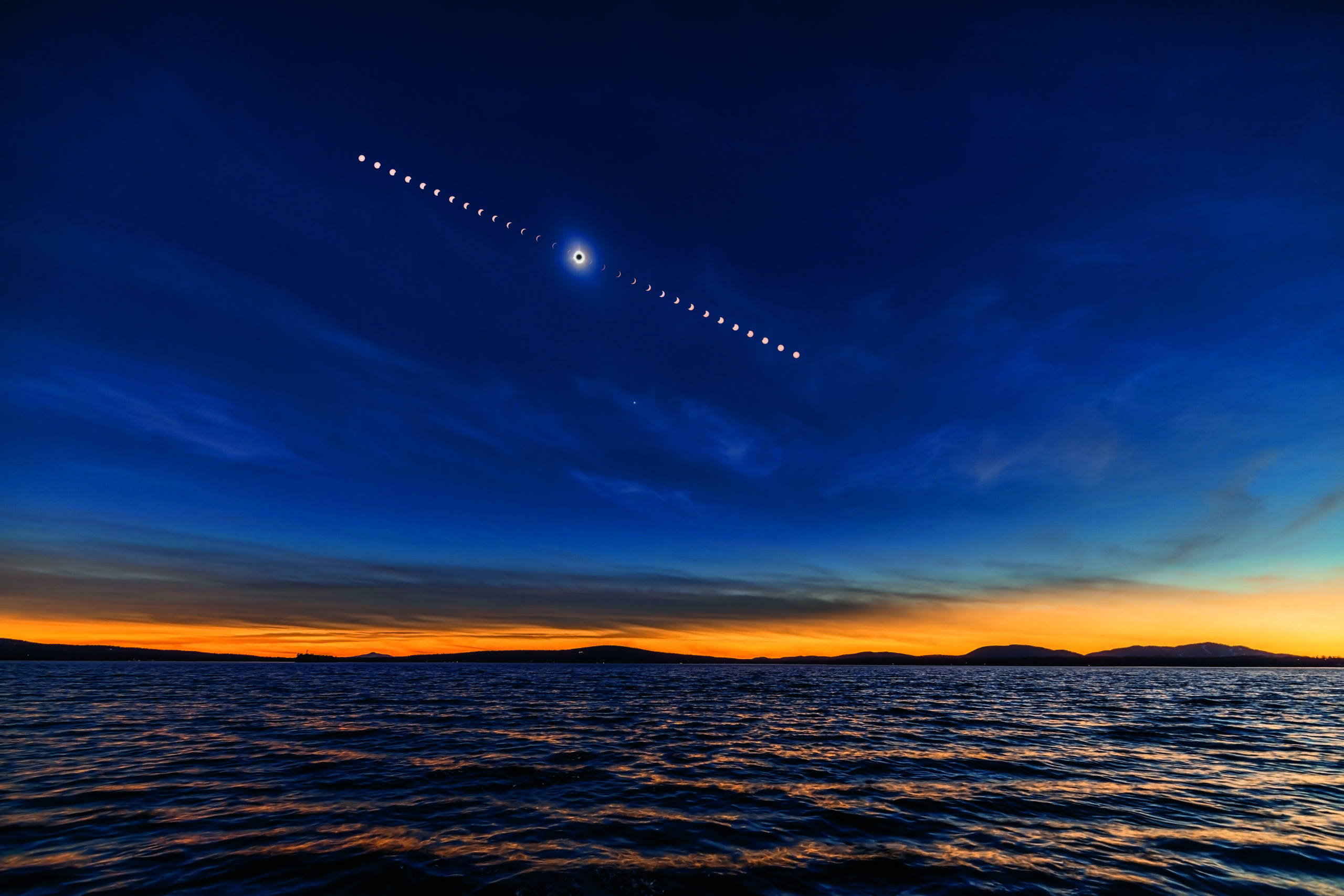 Total eclipse sequence over the waters of Lac Brome, in the Eastern Townships of Quebec, Canada, on April 8, 2024. Credit: Alan Dyer
On the evening of 12 August 2026, the Moon will pass between Earth and the Sun, producing a striking solar eclipse. The Moon’s dark umbral shadow will cross eastern Greenland and the western tip of Iceland before travelling over Spain and ending at sunset near the Balearic Islands.
Across the UK, the event will be visible as a deep partial eclipse. The Moon will cover around 90 per cent of the Sun at maximum, rising to about 95 per cent in the far southwest, leaving a thin crescent hanging low in the western sky. Although observers in Britain will not see totality, the eclipse should create an atmospheric transformation as daylight fades and the landscape often takes on a cooler, silvery appearance.
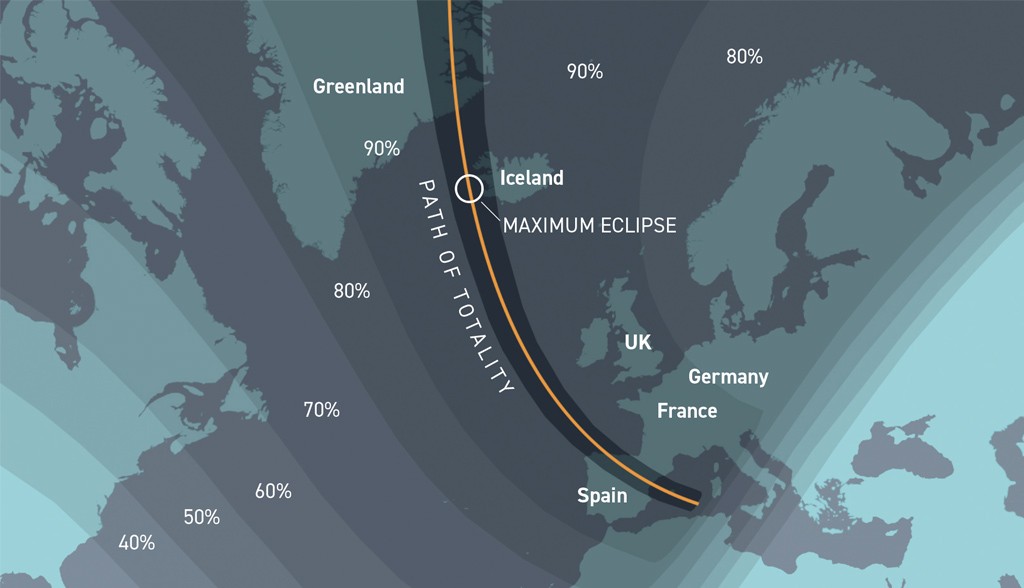 The path of the August 2026 solar eclipse. Credit: Astronomy Now
When to watch
The path of the August 2026 solar eclipse. Credit: Astronomy Now
When to watch
Exact timings will vary with location, but across much of central Britain:
Because the Sun will be close to the western horizon, choosing a location is especially important. Buildings, trees and distant hills may obstruct the view, particularly near maximum eclipse. Visit your planned observing site beforehand, ideally at around the same time of evening, and check that you have a clear sightline towards the west.
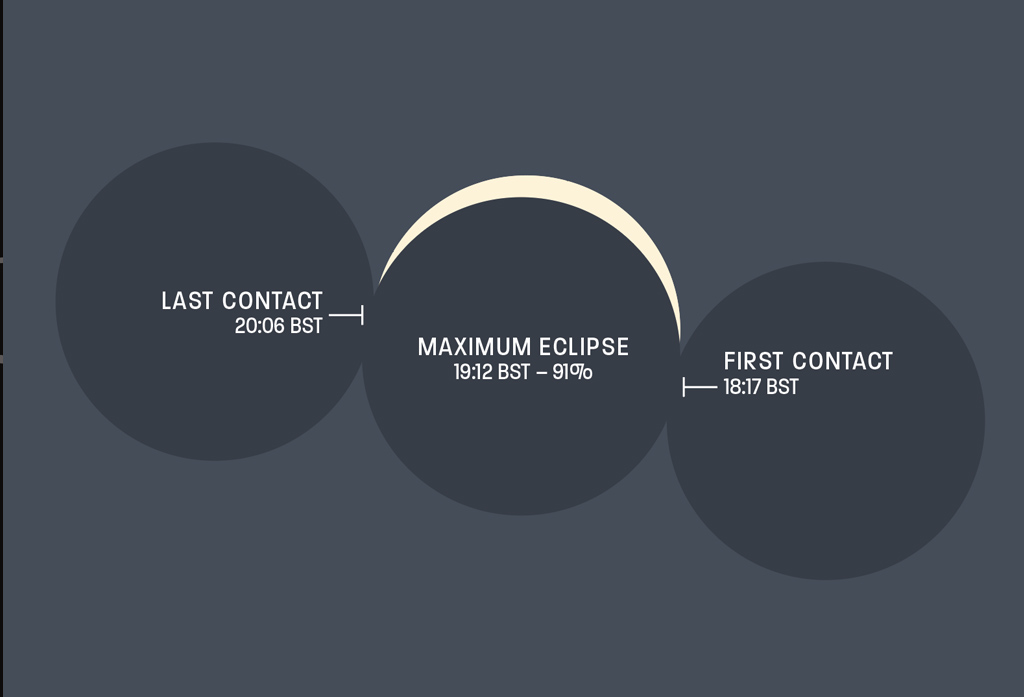 Timings for the 12 August solar eclipse as seen from Greenwich, UK.
The eclipse begins when the Moon appears to take its first small bite from the Sun. As the event progresses, the bright disc will narrow into an increasingly delicate crescent. The changing quality of the light may be just as memorable as the eclipse itself.
Protect your eyesEven when 90 per cent of the Sun is covered, the remaining crescent is still dangerously bright. Never look directly at the Sun without ISO 12312-2 certified solar eclipse glasses or a proper solar filter. The same rule applies to cameras, binoculars and telescopes: each must be fitted with an appropriate solar filter before being pointed at the Sun.
No filter? No problem. Use a kitchen colander!If you do not have suitable equipment, you can observe the eclipse indirectly. Hold a kitchen colander between yourself and the Sun and look at the ground beneath it: the gaps will project multiple tiny images of the eclipsed Sun. Gaps between leaves can produce the same effect, scattering little crescent Suns across a wall, path or sheet of card.
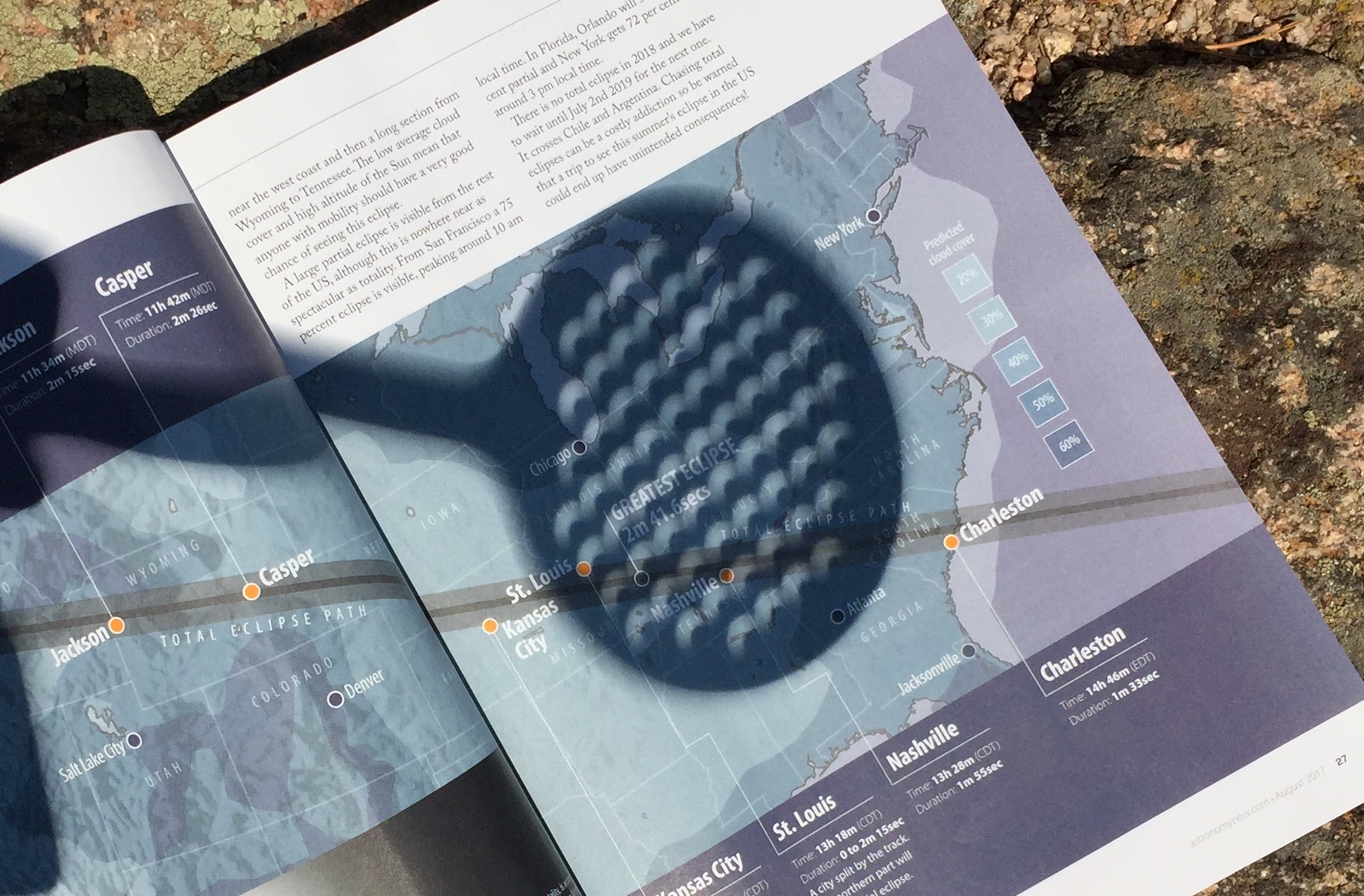 Astronomy Now’s Greg Smye-Rumsby used a colander to project a previous eclipse onto none other than a copy of Astronomy Now magazine!
These projection methods are simple, safe and sociable. If clouds obscure the event – or if you cannot find a safe observing location – watching a reputable live stream is a better choice than taking risks with the Sun.
Photographing the eclipse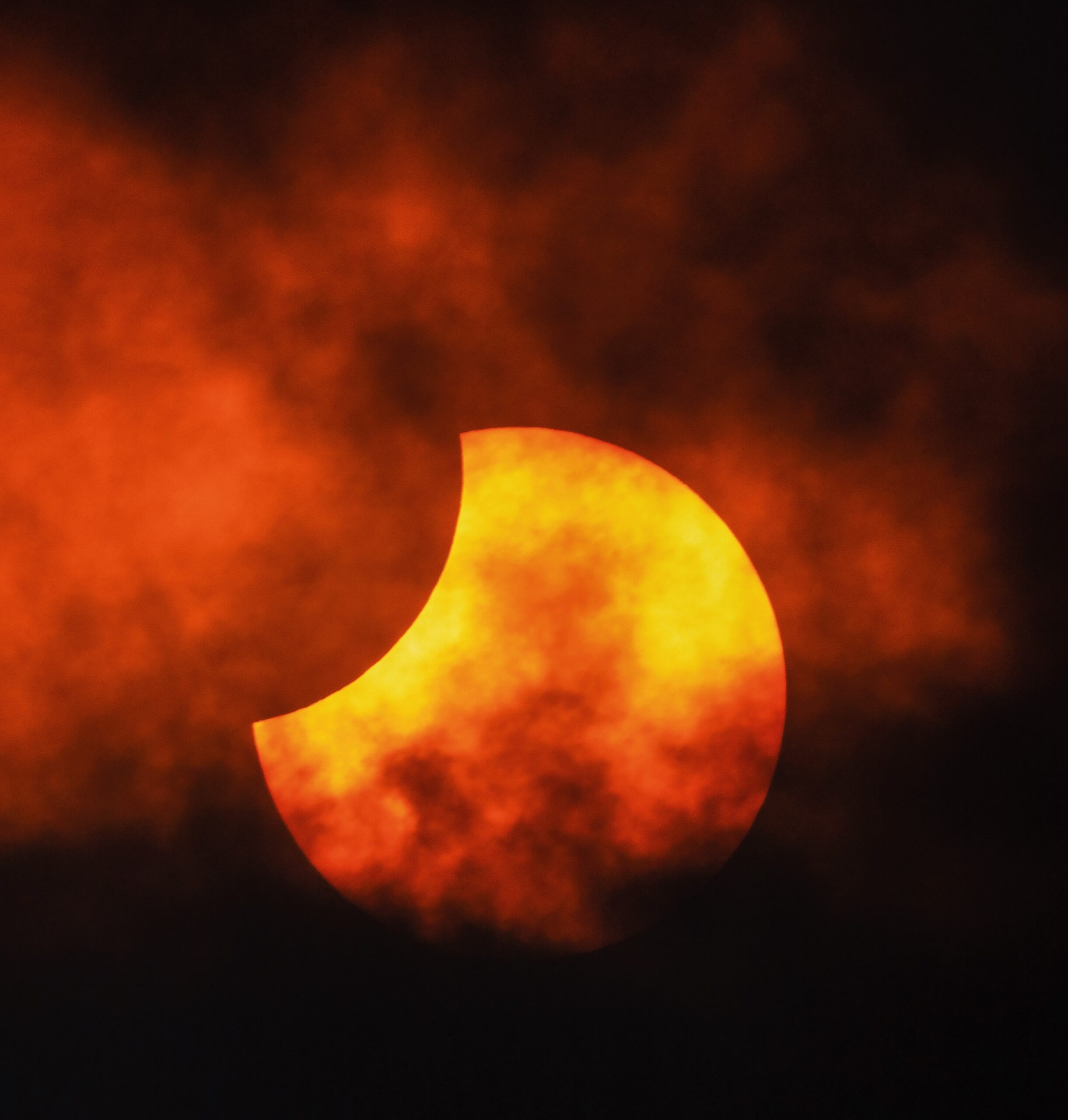 A partial eclipse through clouds. Credit: Alan Tough.
The simplest approach is often the most rewarding. A smartphone can record the changing light and the reaction of the people around you, especially when used for a wide view rather than a heavily zoomed-in image. Mounting the phone on a tripod and recording video a few minutes before maximum eclipse can capture the gradual fall of daylight and the atmosphere of the occasion.
For DSLR or mirrorless cameras, a wide-angle time-lapse is a low-stress option. Include both the Sun and the surrounding landscape, use manual focus, shoot in RAW and begin taking frames about once a second as the eclipse approaches maximum. A tripod will keep the composition steady while you step back to experience the event.
Close-up photography is considerably more demanding. For observers travelling into the path of totality, long focal lengths, careful focusing, tracking and multiple exposures are needed to record features such as the corona and prominences. Solar filters must remain in place during the partial phases and be removed only when the Sun is completely covered – something that will occur only for observers within the path of totality. The filter must be replaced immediately as totality ends.
For observers in the UK, where the eclipse remains partial, the filter should never be removed. Unless you already have experience with high-magnification eclipse photography, a wide-angle time-lapse or unattended video will provide a better balance between recording the event and actually enjoying it.
 Let us know how you get on! Email images to gallery2026@astronomynow.com or share your experience via yourspace@astronomynow.com
Find out more in the current issue of Astronomy Now – take out a digital subscription for instant access!
| # | Наименование новости | Тональность | Информативность | Дата публикации |
|---|---|---|---|---|
| 1 | What time is the total solar eclipse on Aug. 12, 2026? | 0 | 17.17 | 10-08-2026 |
| 2 | Did You See the Solar Eclipse? Here’s What We Saw, from Around the World | 0 | 8.18 | 13-08-2026 |
| 3 | Солнечное затмение 12 августа 2026 года: как это было Фото: ... | 0 | 11.56 | 13-08-2026 |
| 4 | Total solar eclipse August 12, 2026: Best images | 0 | 12.78 | 12-08-2026 |
| 5 | The August 12, 2026 New Moon Solar Eclipse’s Spiritual Meaning | 0 | 14.69 | 10-08-2026 |
| 6 | Солнечное затмение 12 августа 2026 года: трансляция, обновляется | 0 | 19.78 | 11-08-2026 |
| 7 | Полное солнечное затмение 12 августа 2026 года: где его можно увидеть | 0 | 12.89 | 12-08-2026 |
| 8 | Онлайн трансляция солнечного затмения 12 августа 2026 года | 0 | 16.76 | 12-08-2026 |
| 9 | Total solar eclipse 2026 thrills millions with a stunning cosmic spectacle (photos, video) | 0 | 12.94 | 12-08-2026 |
| 10 | Точные даты коридора затмений в августе-2026 и как пережить кармический ... | 0 | 4.77 | 04-08-2026 |