Просмотр новости
Найдите то, что Вас интересует
 Спутники
 РН
РН SpaceX
 Роскосмос
 NASA
NASA
СпутникиРНSpaceXРоскосмосNASALAPost/Los Angeles (August 17, 2026) —...
LAPost/Los Angeles (August 17, 2026) — By: Richard Ren/LAPost
If the Korean Wave of more than a decade ago was largely a cultural phenomenon spreading outward from South Korea, KCON LA 2026 offered a striking glimpse of what comes next: Hallyu is no longer simply about Korean culture going global. It is increasingly about building local cultural ecosystems, developing artists, and creating new forms of content in markets around the world.
Held August 14–16, KCON LA 2026 drew approximately 142,000 fans over three days at the Los Angeles Convention Center and Crypto.com Arena, featuring 36 acts and 144 participating brands and companies. Under the theme “K-SOUL CITY,” the festival transformed Los Angeles into a cultural destination inspired by the energy and spirit of Seoul, while digital platforms extended the experience to more than 250 regions worldwide.
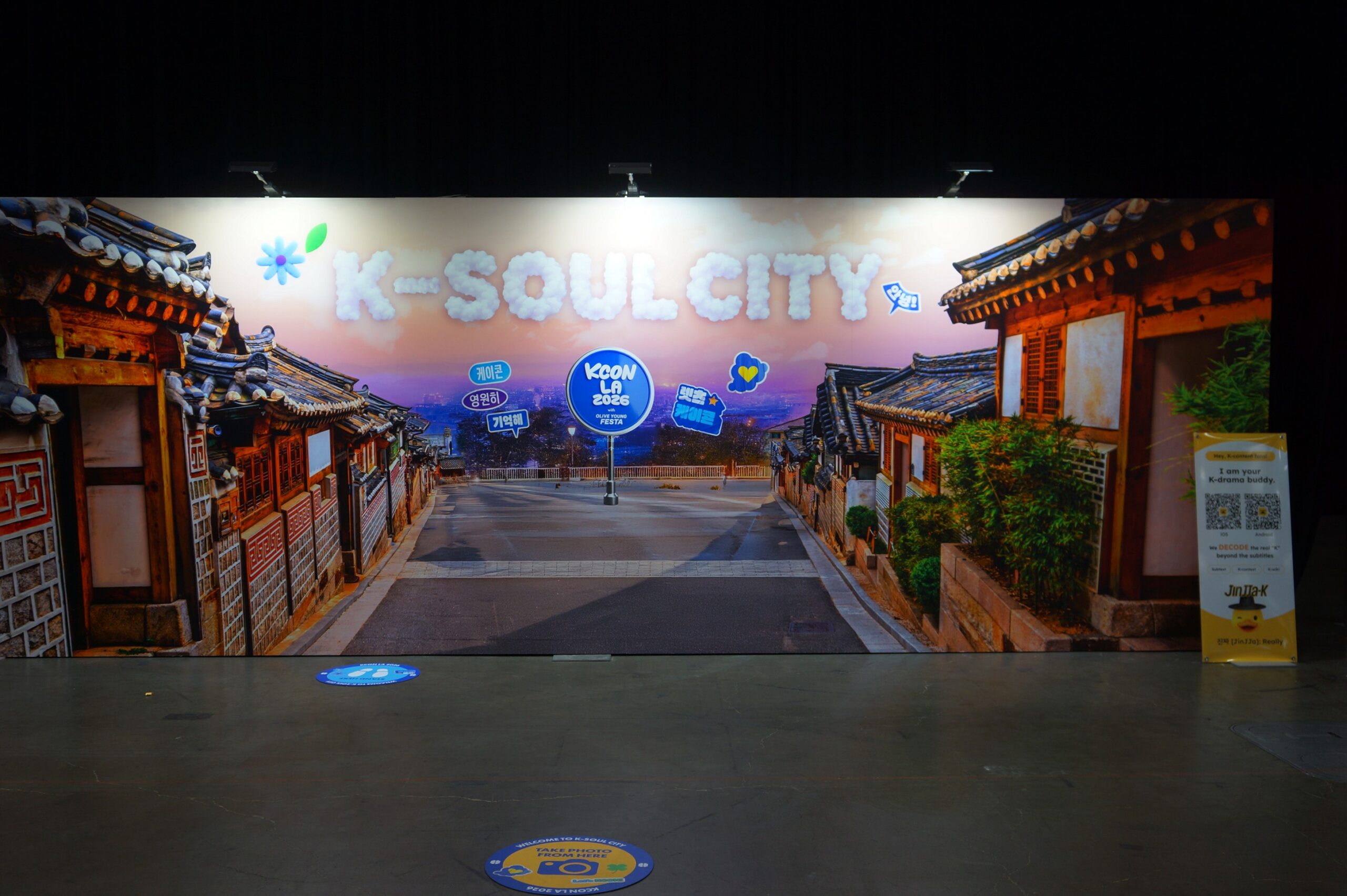
(Photo by Richard Ren/LAPost)
Now in its 14th year in the United States, KCON has become far more than a K-pop concert.
It has evolved into a massive K-culture ecosystem, bringing together music, beauty, food, film, television, fashion, lifestyle and emerging brands in a single cultural marketplace.
And perhaps the most significant development at this year’s festival was not simply which Korean superstars appeared onstage, but the growing number of artists from non-Korean cultural backgrounds entering the KCON ecosystem.
From Asia to the World: The Korean Wave’s Two-Decade JourneyThe global rise of Hallyu did not happen overnight.
Beginning in the late 1990s and early 2000s, Korean television dramas and popular music first gained momentum across China, Japan, Taiwan, Hong Kong and Southeast Asia. Television series, music and celebrity culture became the initial entry points. Korean films, variety shows, webtoons, games, beauty products and food subsequently expanded the cultural footprint.
The streaming era accelerated that process. Global hits such as Squid Game demonstrated that Korean storytelling could transcend language and geography, while artists such as BTS and BLACKPINK helped establish K-pop as a major force in Western popular culture.
Today, however, Hallyu has entered a fundamentally different stage.
According to South Korea’s Ministry of Culture, Sports and Tourism and the Korea Foundation for International Cultural Exchange, an analysis of roughly 1.5 million overseas media reports and social-media posts from October 2024 through September 2025 found that Asia accounted for 44% of Hallyu-related coverage, followed by Europe at 20.8% and North America at 16.9%. K-pop remained the most prominent Hallyu category across much of Asia, Europe, North America and Latin America.
More importantly, the definition of Hallyu itself is expanding.
The United States has emerged as one of the world’s largest markets for Korean cultural coverage, while interest in Korean literature has grown in Japan, Korean dramas have attracted particular attention in Vietnam, and Korean cinema has generated strong interest in Brazil. K-food has also become an increasingly visible component of the global Korean cultural economy.
In other words, Hallyu is no longer synonymous with K-pop.
It is becoming a multi-industry cultural ecosystem.
KCON: From Concert to Global PlatformKCON itself is one of the clearest examples of this transformation.
The first KCON was held in Irvine, California, in 2012, drawing roughly 10,000 fans. By 2019, KCON had surpassed one million cumulative in-person attendees worldwide, while the 2019 Los Angeles edition alone attracted approximately 103,000 people.
During the pandemic, KCON expanded further through digital programming, allowing its content to reach audiences around the world.
Since then, KCON has continued to expand into markets including Japan, France, Mexico, the United Arab Emirates, Thailand, Australia and Saudi Arabia.
By 2026, CJ ENM said KCON had held events across 14 regions in Asia, the Middle East, Europe and the Americas, with cumulative in-person attendance approaching 2.23 million.
That is why KCON LA 2026 should not be viewed simply as another showcase for Korean celebrities.
It represents a more sophisticated globalization model:
Use K-pop to attract attention, then connect that audience to K-beauty, K-food, K-drama, K-movie and lifestyle products — ultimately creating a localized ecosystem in each market.
That strategy helps explain why this year’s KCON lineup extended well beyond traditional Korean acts.
Japanese, Chinese, American and Latin American Artists on the Same PlatformKCON LA 2026 offered a particularly revealing snapshot of this cultural convergence.
Japanese representation was increasingly visible. Groups and projects connected to Japan’s rapidly developing idol ecosystem appeared alongside Korean acts, reflecting the growing interaction between Japan’s music market and the K-pop industry.
Chinese cultural representation was also notable.
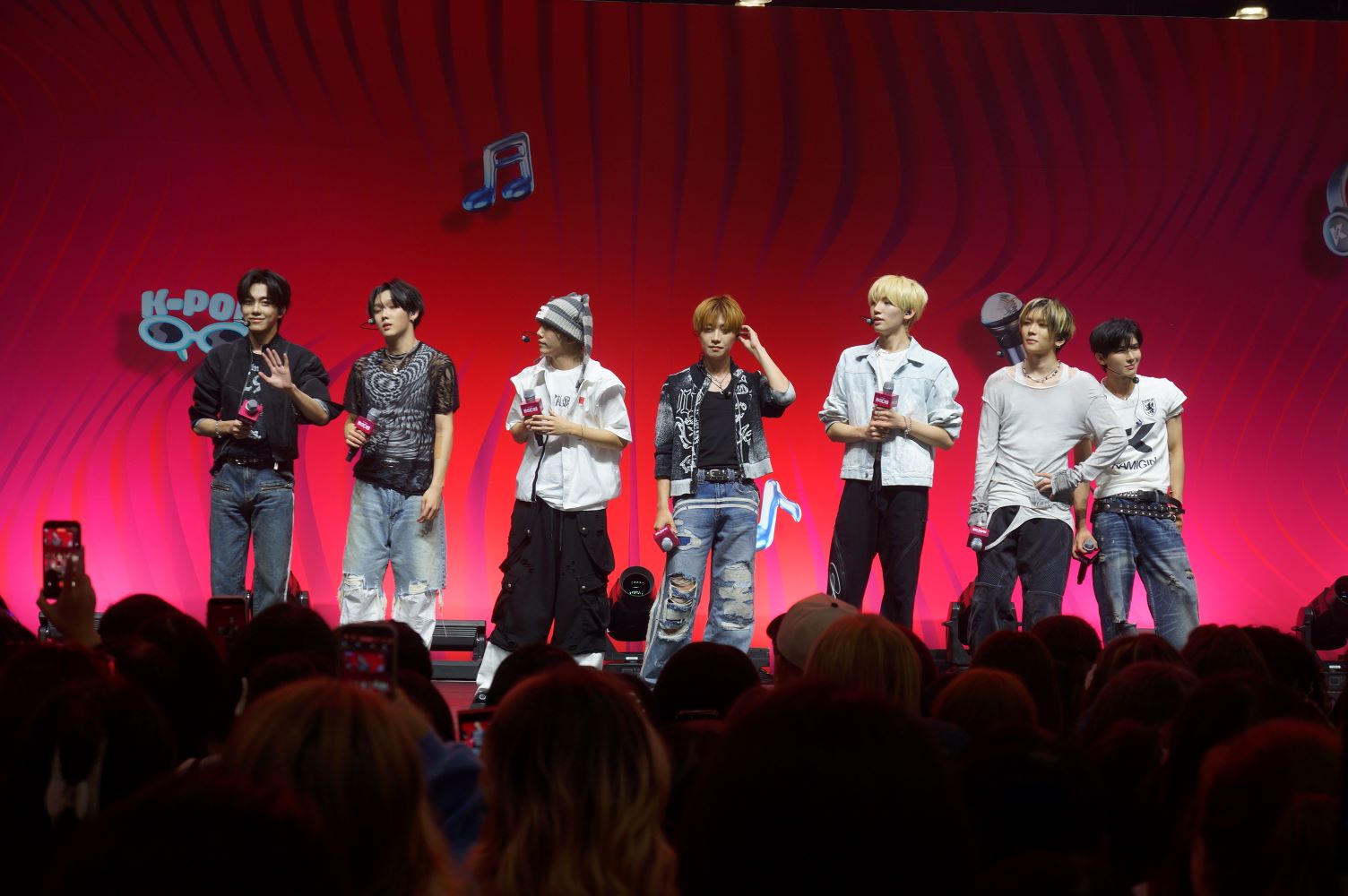
MODYSSEY (Photo by Richard Ren/LAPost)
MODYSSEY, a newly debuted boy group with a strong Chinese identity, appeared at KCON LA 2026. Its presence demonstrated how young artists with Chinese cultural backgrounds can increasingly enter and participate in the broader KCON ecosystem.
This is not an isolated phenomenon.
KCON is gradually moving from a model in which Korean artists perform for international audiences toward one in which young artists from different cultural backgrounds participate in the same Korean-inspired entertainment ecosystem.
At the same time, KCON LA 2026 incorporated American musical talent, including artists such as Anderson .Paak, creating a direct intersection between Korean entertainment, American pop and hip-hop culture, and local music.
But perhaps the most strategically significant development came from Latin America.
SANTOS BRAVOS: A Sign That Hallyu Is Becoming Truly LocalOne of the most consequential moments at KCON LA 2026 was the appearance of SANTOS BRAVOS on the M COUNTDOWN main stage.

M-COUNTDOWN_SANTOS-BRAVOS-01-CCJ-ENM
Developed by HYBE Latin America, the five-member group is not a conventional Korean idol act. Instead, it represents an effort to combine Latin American cultural identity with elements of Korea’s highly developed artist-training and entertainment system.
The group emerged through a Latin American audition and competition project, with a training system influenced by the Korean idol-development model.
That makes SANTOS BRAVOS particularly important from a global cultural-industry perspective.
The old Hallyu model was relatively straightforward:
Korea produces content → the content is exported → international audiences consume it.
SANTOS BRAVOS points toward a new model:
Korea exports the methodology → local artists are developed → local languages and cultural identities are incorporated → local content is produced → the content enters the global marketplace.
In other words, the Korean entertainment industry is increasingly exporting not just products, but an entire cultural production system.
SANTOS BRAVOS performs largely in Spanish and is designed to connect with the enormous cultural and consumer markets of Latin America.
It would therefore be too simplistic to describe the group simply as a “Latin K-pop group.”
It is better understood as an experiment:
What happens when K-pop’s training systems, fan-management strategies, visual language and stage production are placed inside a Latin American cultural environment?
The answer received an immediate response in Los Angeles.
When SANTOS BRAVOS took the Crypto.com Arena stage on August 14, the audience erupted with extraordinary cheers and screams. For a relatively new Latin American group entering the global market, the response represented an important signal.
They were not merely being received as international guests.
They were being welcomed as part of the KCON fan ecosystem itself.
That distinction may ultimately prove to be one of the most important developments in the future of Hallyu.
The Real Power of Hallyu Is Not Just Stars — It Is the EcosystemAnother easily overlooked number from KCON LA 2026 is 144 participating brands and companies.
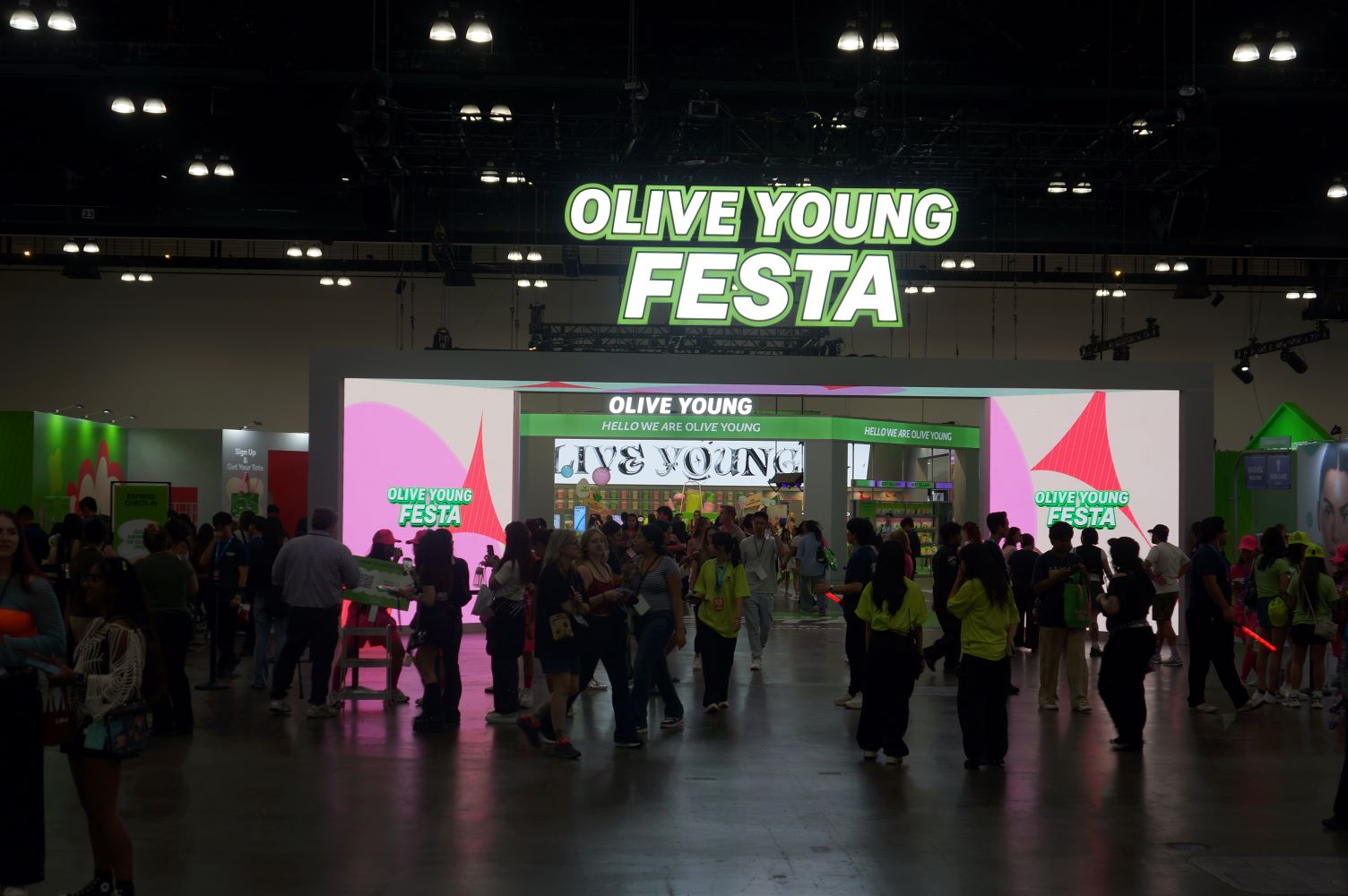
(Photo by Richard Ren/LAPost)
That figure illustrates how far KCON has moved beyond the concert model.
A young fan may first discover Korean culture through a K-pop group. That fan may then begin watching Korean dramas, buying Korean skincare products, eating Korean food, watching Korean films, following Korean fashion and eventually considering Korea as a travel destination.
This is the logic of cultural-industrial integration.
One of the strengths of South Korea’s cultural economy is not simply that individual products are successful. It is that different industries can continuously direct audiences toward one another.
K-pop creates fandom. K-drama creates stories. K-movie expands cultural expression. K-beauty enters consumers’ daily routines. K-food reaches the dinner table. K-fashion enters the wardrobe. Together, they form K-lifestyle.
KCON has become a physical manifestation of that strategy.
Since its launch in 2012, KCON has attracted more than two million in-person attendees worldwide, while its programming has increasingly combined music with beauty, food, lifestyle and broader Korean cultural content.
The economic scale of Korea’s cultural industries is also expanding. South Korean government data showed that the country’s content-industry exports reached a record $14.08 billion in 2024, up 5.5% year over year, with gaming accounting for the largest share and music, broadcasting and film also contributing significantly.
This is why Hallyu can no longer be measured simply by music charts.
From “Made in Korea” to “Made Together Around the World”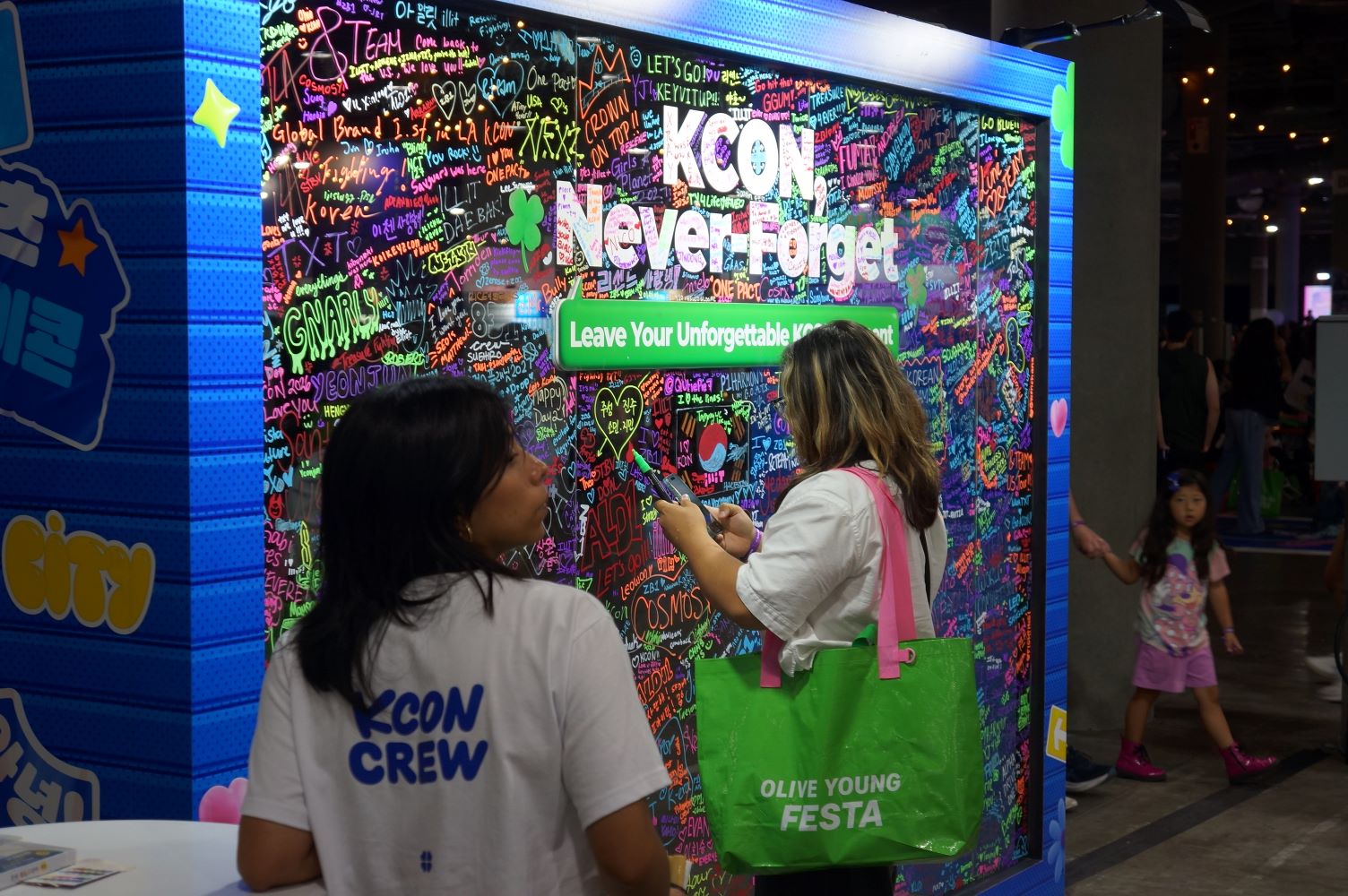
(Photo by Richard Ren/LAPost)
The most important change at KCON LA 2026 can ultimately be summarized in one word:
Localization.
Japanese artists are entering the KCON ecosystem.
Artists with Chinese cultural backgrounds are participating.
American musicians are appearing on the same platform.
And Latin American artists are increasingly being developed through Korean entertainment-industry systems.
Hallyu is therefore undergoing a transformation not only in scale, but also in identity.
The traditional concept of the “Korean Wave” emphasized Korean culture spreading outward from South Korea.
What is emerging today is closer to Global K-Culture.
South Korea remains an important center for creative development, production expertise and entertainment infrastructure. But the creators themselves increasingly come from different countries and cultural backgrounds.
That helps explain why the theme of this year’s KCON LA was “K-SOUL CITY.”
The goal was not simply to turn Los Angeles into a miniature Seoul.
Instead, the festival created a cultural city in which Korean cultural elements intersected with American popular culture, Japanese music, Chinese cultural influences and Latin American identity.
From Asia to the World — and Toward Global Cultural FusionKCON’s 14-year evolution is itself a map of Hallyu’s globalization.
In 2012, approximately 10,000 people attended the first KCON in California.
Today, KCON has expanded across Asia, Europe, the Middle East and the Americas, while its digital programming reaches audiences around the world.
KCON LA 2026 now raises an even more consequential question:
What will the next generation of global Hallyu artists look like if they do not necessarily come from Korea?
They could be Japanese.
They could be Chinese.
They could be American.
They could be Latin American artists performing in Spanish.
That may ultimately be the key to Hallyu’s long-term sustainability.
A culture with lasting global influence does not survive by remaining unchanged. It survives by entering other societies, being reinterpreted by different communities, and generating new forms of cultural expression.
In that sense, the deafening response to SANTOS BRAVOS at Crypto.com Arena was about more than a new group making its KCON debut.
It represented something larger:
Hallyu is evolving from a culture exported from Korea into a global culture increasingly created with the participation of the world.
And that may be the real next chapter of the Korean Wave.
From K-pop to K-lifestyle, from Korean artists to global artists, and from cultural export to cultural co-creation, KCON LA 2026 may have offered one of the clearest signals yet of where Hallyu is headed in the decade ahead.
| # | Наименование новости | Тональность | Информативность | Дата публикации |
|---|---|---|---|---|
| 1 | 从“韩流输出”到“全球共创”:KCON LA 2026折射韩流文化的下一阶段 | 0 | 37.46 | 18-08-2026 |
| 2 | KCON LA 2026落幕:142,000人共赴“K-SOUL CITY”,韩流从洛杉矶走向全球 | 0 | 37.56 | 18-08-2026 |
| 3 | MODYSSEY’s Global “Musical Odyssey” — Seven Chinese Members Take the Stage at KCON LA 2026 | 0 | 40.62 | 18-08-2026 |
| 4 | KCON LA 2026 Wraps Landmark Edition, Bringing K-SOUL CITY to Where it All Began | 0 | 46.97 | 18-08-2026 |
| 5 | KCON LA 2026公布M COUNTDOWN STAGE三天阵容 NCT 127、ZEROBASEONE、TXT三晚领衔登场 | 0 | 35.85 | 05-08-2026 |
| 6 | KCON LA 2026发布最新入场规定:白天会展中心与晚间演唱会“限包”政策不同 | 0 | 38.1 | 11-08-2026 |
| 7 | OLIVE YOUNG Brings Signature K-Beauty Festival To The U.S. With OLIVE YOUNG FESTA LA 2026 | 5 | 7 | 01-07-2026 |
| 8 | When AI Enters Hollywood, the Hardest Part May Be Knowing What to Create | 0 | 37.67 | 18-09-2026 |
| 9 | “华文漪将昆曲带到北美”——加州大学洛杉矶分校圆桌论坛回顾艺术家生平与传承 | 0 | 40.29 | 11-02-2026 |
| 10 | Samsung porta a Gamescom 2026 le innovazioni gaming | 0 | 21.63 | 13-08-2026 |