Просмотр новости
Найдите то, что Вас интересует
 Спутники
 РН
РН SpaceX
 Роскосмос
 NASA
NASA
СпутникиРНSpaceXРоскосмосNASADPhil student Julian Wyatt has won a challenge at MICCAI 2024, the International Conference on Medical Image Computing and Computer Assisted Intervention.
Posted: 21st November 2024
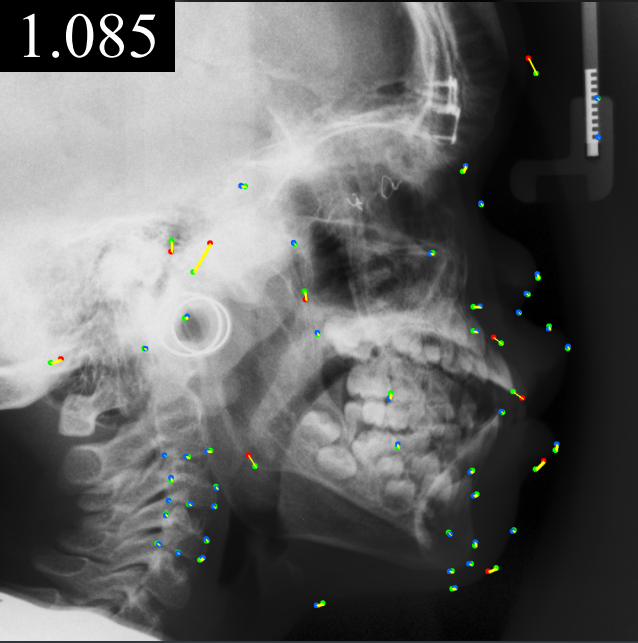 Sample result: blue dots represent landmark predictions within 2mm of the ground truth, red dots are further than 2mm, green dots are ground truth, and yellow lines connect predictions to ground truth.
DPhil student Julian Wyatt has won a challenge at MICCAI 2024, the International Conference on Medical Image Computing and Computer Assisted Intervention.
Julian achieved first place in the ‘CL-Detection 2024: Cephalometric Landmark Detection in Lateral X-Ray Images’ international challenge. Candidates were required to develop a model that could detect 53 landmarks on a diverse dataset of 700 Cephalometric x-rays. The challenge assessed both efficiency and accuracy in accordance with real clinical practice.
Quote from Julian: I am thrilled that several months of dedicated effort have allowed us to achieve such accurate results. This accomplishment means our model is now better at recognising landmarks in new x-ray domains. The method and results will be published in a paper co-authored with my supervisor Irina Voiculescu.
Cephalometric analysis
Cephalometric analysis involves an examination of the dental and skeletal relationships of the human skull. Healthcare professionals such as orthodontists and orthognathic surgeons analyse cephalometric x-rays to study the relationships between bony and soft tissue landmarks to inform treatment decisions. The identification of these craniofacial landmarks is labour-intensive and time-consuming, even when performed by experienced clinicians. Fully automatic accurate landmark localisation can reduce annotation time whilst maintaining quality of care.
The work was funded by an EPSRC Research Scholarship and used the University’s Advanced Research Computing service.
| # | Наименование новости | Тональность | Информативность | Дата публикации |
|---|---|---|---|---|
| 1 | Oxford researchers awarded Best Paper at CVPR 2025 | 0 | 15.73 | 30-06-2025 |
| 2 | Professor Irina Voiculescu and colleagues recognised at MIUA 2025 for work on medical image segmentation | 0 | 11.77 | 11-08-2025 |
| 3 | Kai Lu wins two robotics awards at IROS 2024 | 0 | 8.71 | 12-12-2024 |
| 4 | Atsushi Shirahama wins All-Innovate award for AI construction platform | 0 | 14.31 | 01-04-2025 |
| 5 | DPhil student Mihaela Stoian recognised with G-Research Prize | 0 | 17.57 | 09-07-2025 |
| 6 | Professor Wooldridge awarded Schmidt Sciences AI2050 Senior Fellowship | 0 | 12.5 | 11-12-2024 |
| 7 | Michael Wooldridge Receives Faraday Prize from Royal Society | 0 | 12.57 | 27-08-2025 |
| 8 | Aurore Lyon wins the Young Investigator Award in the Computing in Cardiology Conference | 0 | 6.53 | 11-09-2015 |
| 9 | Студенты ИКТЗИ отмечены по итогам ВИК-2026 | 0 | 7.16 | 01-01-1970 |
| 10 | Студент СГУ стал победителем Кубка РФ по программированию БАС | 0 | 0 | 27-04-2025 |