Просмотр новости
Найдите то, что Вас интересует
 Спутники
 РН
РН SpaceX
 Роскосмос
 NASA
NASA
СпутникиРНSpaceXРоскосмосNASA
By Shawn Roslin, Vice President of National Intelligence Division and International Programs
Artificial intelligence is no longer a future concern—it is an active force reshaping the global security landscape. One of the most dangerous uses is deepfake technology: AI-generated audio, video, and imagery that can convincingly fabricate reality. What began as a novelty has rapidly evolved into a powerful tool for deception, manipulation, and strategic disruption.
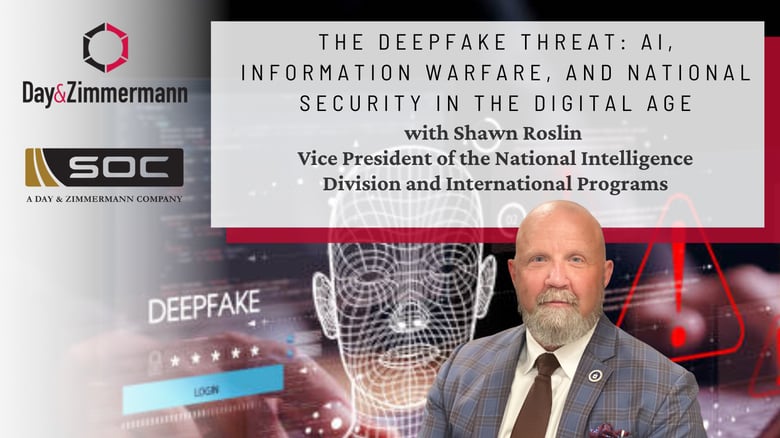
By Shawn Roslin, Vice President of National Intelligence Division and International Programs
Artificial intelligence is no longer a future concern—it is an active force reshaping the global security landscape. One of the most dangerous uses is deepfake technology: AI-generated audio, video, and imagery that can convincingly fabricate reality. What began as a novelty has rapidly evolved into a powerful tool for deception, manipulation, and strategic disruption.
At its core, deepfake technology undermines one of the most fundamental pillars of modern society: our trust in information.
A New Era of Information Warfare
Deepfakes represent a dramatic escalation in information warfare. Unlike traditional propaganda, deepfakes can create entirely false realities that are nearly indistinguishable from authentic content. One of the greatest challenges is keeping pace with the rapid evolution of deepfake technology, as these tools become more widely available, increasingly convincing, and more difficult to detect.
In July of 2025, a widely reported incident involved an AI-generated voice posing as Secretary of State Marco Rubio and sent messages to at least three foreign ministers, a U.S. senator, and a governor. The deepfake included at least two voicemails and a text message sent via the messaging app Signal.
In May 2025, President Trump's chief of staff, Susie Wiles, was targeted by a similar attack when her phone was compromised and used to place calls and send messages to senators, governors, and business executives while impersonating her.
Additionally in 2024, an AI-generated robocall in New Hampshire used former President Biden's voice to discourage voters from participating in the state’s presidential primary.
The misuse of AI to deceive is likely to grow as technology improves and becomes more widely available. This capability allows actors to:
The result is a destabilized environment where the truth becomes increasingly difficult to verify and increasingly easy to dismiss.
The Loss of Reality and Public Trust
Perhaps the most dangerous effect of the increase in deepfake cases is what experts call the “liar’s dividend”—the ability for actors to dismiss authentic evidence as fabricated.
At the beginning of this year, a deepfake video in India falsely depicted Bombay Stock Exchange CEO Sundararaman Ramamurthy giving investors stock advice while promising great returns.
"The latest data shows that over the past two years or so, we've seen an increase of almost 3,000% in the number of deepfakes being utilized," said Karim Toubba, the chief executive of US-based password security company LastPass.
Deepfakes severely damage public trust in journalism. A study from Utah Valley University’s Center for National Security Studies found that more than 50% of participants struggled to distinguish deepfakes from real content. When individuals can no longer tell the difference between real and artificial media, the consequences ripple across society.
The growing use of deepfakes in political, financial, and social contexts demonstrates that this is no longer a hypothetical threat—it is a present reality with serious implications for national security and public trust. Addressing this challenge will require a coordinated effort between government agencies, technology companies, media organizations, and the public. The ability to distinguish truth from deception may become one of the defining national security
| # | Наименование новости | Тональность | Информативность | Дата публикации |
|---|---|---|---|---|
| 1 | The Deepfake Threat: Defending Truth in the Age of AI | 0 | 10.73 | 13-07-2026 |
| 2 | So gefährlich sind Deepfakes | -2 | 6 | 10-06-2026 |
| 3 | The Rise of AI Influencers: Can Users Still Tell What's Real? | 0 | 7 | 23-06-2026 |
| 4 | Que fait la Suisse face à la menace des «deepfakes» générés par l'IA? | 0 | 5.48 | 12-07-2026 |
| 5 | AI and deepfakes driving $68 bn US scam epidemic – survey | 0 | 5 | 01-07-2026 |
| 6 | Visual Deepfake Detection: Review of Techniques, Tools, Limitations, and Future Prospects | 0 | 7.64 | 27-12-2024 |
| 7 | Why audio deepfakes are so hard to spot | 0 | 7 | 14-05-2026 |
| 8 | The government wants to rein in powerful AI, but there are downsides | 0 | 5 | 27-06-2026 |
| 9 | Pourquoi l’IA provoque un nouveau séisme dans les médias, fragilisés par vingt ans de mutations numériques | 0 | 7.94 | 11-08-2026 |
| 10 | Deepfake-Bilder zuverlässig erkennen und transparent erklären | 0 | 14.65 | 01-07-2026 |