Просмотр новости
Найдите то, что Вас интересует
 Спутники
 РН
РН SpaceX
 Роскосмос
 NASA
NASA
СпутникиРНSpaceXРоскосмосNASAEverlight Electronics Co., Ltd., a publicly traded Taiwanese LED manufacturer, and its Texas-based subsidiary Everlight Americas, Inc. have agreed to pay the United States $5.15 million to resolve allegations that they knowingly failed to pay duties owed on light-emitting diodes imported from the People’s Republic of China. The settlement, announced August 5 by the U.S. Attorney’s Office for the District of Maryland alongside U.S. Customs and Border Protection’s Office of Trade, resolves claims under the False Claims Act, the Tariff Act of 1930 as amended, and common law.
The case originated as a qui tam action filed by Tao Wang, a former Everlight employee, captioned United States ex rel. Wang v. Everlight Electronics Co., Ltd., et al., No. TDC-21-cv-1607 (D. Md.). Wang will receive $876,146, approximately 17 percent of the total recovery.
What distinguishes this settlement from a garden-variety origin-fraud case is that it covers two distinct patterns of conduct, and the second is the more technically interesting of the pair. The first period, July 2018 to January 2022, tracks the classic transshipment fact pattern: Everlight manufactured its LEDs in China, routed them through Taiwan, and then declared that the products originated in Taiwan to avoid the Section 301 tariffs that Chinese-origin LEDs carried during that window. The second period, January 2022 through November 2025, alleges something subtler. Everlight continued importing LEDs from Taiwan, but some of those products were Chinese in origin by virtue of the dice, the semiconductor chips at the heart of each diode, and the company allegedly did not segregate Chinese-made dice from Taiwanese-made dice during the packaging process.
That second theory matters well beyond Everlight. It reflects the substantial-transformation doctrine as CBP has been applying it to semiconductors: assembly and packaging operations performed on a foreign-made die frequently do not confer a new country of origin. Any importer that assumes a final assembly step in a low-tariff jurisdiction resets the origin is running up the same exposure. An importer that declares false origin is not merely underpaying the Treasury; it is underselling every honest competitor in a market where the tariff is a larger line item than the manufacturing margin.
Everlight Electronics’ $5.15M FCA Settlement
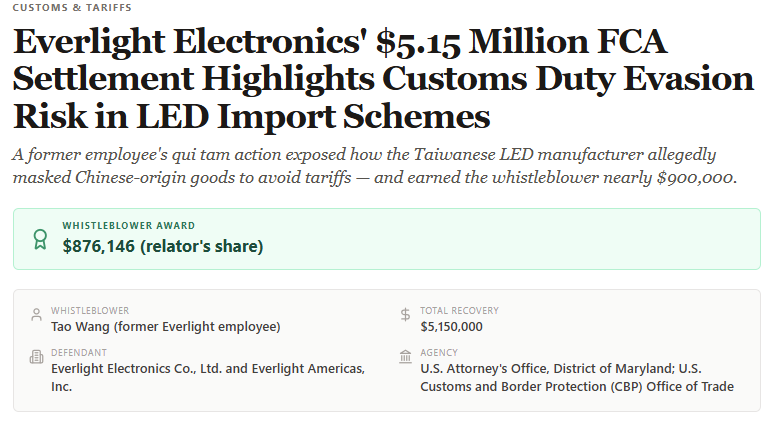
Everlight Electronics Co., Ltd., a publicly traded Taiwanese LED manufacturer, and its Texas-based subsidiary Everlight Americas, Inc. have agreed to pay the United States $5.15 million to resolve allegations that they knowingly failed to pay duties owed on light-emitting diodes imported from the People’s Republic of China. The settlement, announced August 5 by the U.S. Attorney’s Office for the District of Maryland alongside U.S. Customs and Border Protection’s Office of Trade, resolves claims under the False Claims Act, the Tariff Act of 1930 as amended, and common law.
The case originated as a qui tam action filed by Tao Wang, a former Everlight employee, captioned United States ex rel. Wang v. Everlight Electronics Co., Ltd., et al., No. TDC-21-cv-1607 (D. Md.). Wang will receive $876,146, approximately 17 percent of the total recovery.
What distinguishes this settlement from a garden-variety origin-fraud case is that it covers two distinct patterns of conduct, and the second is the more technically interesting of the pair. The first period, July 2018 to January 2022, tracks the classic transshipment fact pattern: Everlight manufactured its LEDs in China, routed them through Taiwan, and then declared that the products originated in Taiwan to avoid the Section 301 tariffs that Chinese-origin LEDs carried during that window. The second period, January 2022 through November 2025, alleges something subtler. Everlight continued importing LEDs from Taiwan, but some of those products were Chinese in origin by virtue of the dice, the semiconductor chips at the heart of each diode, and the company allegedly did not segregate Chinese-made dice from Taiwanese-made dice during the packaging process.
That second theory matters well beyond Everlight. It reflects the substantial-transformation doctrine as CBP has been applying it to semiconductors: assembly and packaging operations performed on a foreign-made die frequently do not confer a new country of origin. Any importer that assumes a final assembly step in a low-tariff jurisdiction resets the origin is running up the same exposure. An importer that declares false origin is not merely underpaying the Treasury; it is underselling every honest competitor in a market where the tariff is a larger line item than the manufacturing margin.