Просмотр новости
Найдите то, что Вас интересует
 Спутники
 РН
РН SpaceX
 Роскосмос
 NASA
NASA
СпутникиРНSpaceXРоскосмосNASAAn EU-funded research team has developed a 3D bioprinting technique that grows living bone, fat and muscle tissue in the lab, with uses stretching from leukaemia research to cultivated meat. The work comes out of PRISM-LT, a five-year project running until 2027 and coordinated scientifically by Massimo Vassalli, professor of bioengineering at the University of…
An EU-funded research team has developed a 3D bioprinting technique that grows living bone, fat and muscle tissue in the lab, with uses stretching from leukaemia research to cultivated meat.
The work comes out of PRISM-LT, a five-year project running until 2027 and coordinated scientifically by Massimo Vassalli, professor of bioengineering at the University of Glasgow. Rather than extruding a continuous stream of cells, the platform assembles tissue from tiny capsules, each carrying living cells, a gel scaffold, and genetically engineered microbes that steer how the cells develop.
That building-block method is the project’s core bet, and its answer to the central problem of the field: how to print living cells into complex shapes without killing them or losing control of what they become.
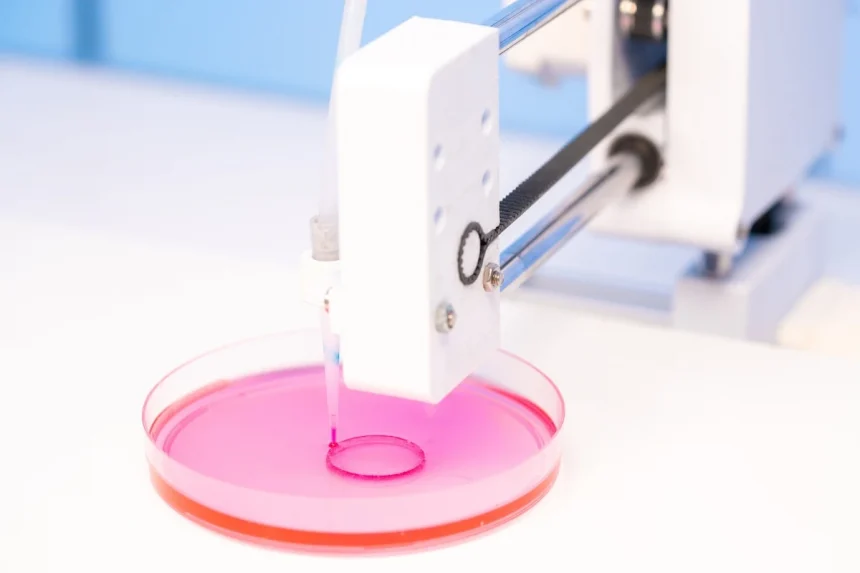 3D bioprinting close up. Photo via Philip Ezze, PRISM-LT.
Living building blocks, not a continuous stream
Conventional bioprinting lays down cells in a flowing bioink with no biological guidance. PRISM-LT instead works with what project coordinator Laura Martinelli, CEO of the Udine-based research organisation InSociety, calls encapsulated living building blocks. “Rather than printing a continuous stream of bioink, we work with encapsulated living building blocks,” she said. “These capsules can either be precisely positioned by a robotic arm or bioprinted layer by layer to create complex tissue architectures.”
Inside each capsule, engineered microbes act as biological guides. They detect when stem cells begin to change, and respond by releasing growth factors that push them toward bone, fat or muscle. The printing itself is quick, taking minutes to an hour, but the tissue then needs a maturation period of roughly three weeks to develop. For now the team can produce about one square centimetre of thin tissue and is working toward a one-cubic-centimetre block.
The hardest part is biological cohabitation. The process forces together organisms that never evolved to share an environment. “We need to create a symbiotic relationship between two systems that were not made to live together, such as yeast and stem cells,” said Vassalli. “The main challenge is to create conditions that are good enough for yeast or bacteria, as well as the stem cells while they differentiate.”
From bone marrow models to the dinner plate
PRISM-LT is chasing two tissue types built on the same principles. The first is the bone-and-fat interface found in bone marrow, aimed at biomedical research; the health focus is on 3D bone marrow models for studying drugs against conditions such as leukaemia. The second is the muscle-fat structure that gives real meat its marbling, the fat streaks behind texture and flavour that have long defeated cultivated meat.
Fat distribution is decisive for whether consumers accept lab-grown meat, and Martinelli frames it as a market unlock. “Thanks to our bioprinting technology, we can achieve the right texture in alternative meats, which creates an opportunity to bring it to the market,” she said. The same platform is also intended to produce miniature tissue models mimicking human organs, for drug testing and personalised medicine.
Consumer perception is shaping design choices as much as biology. For the cultivated-meat work, the team deliberately chose yeast over bacteria as the engineered guide, reasoning that a meat grown with bacteria would be a harder sell at the dinner table. Even so, Martinelli is candid that real-world products remain distant: the project is concentrating on principles and mechanisms rather than a finished offering.
The regulatory frontier
The scientific work is only half the challenge. Because these engineered living materials, or ELMs, combine living cells and sometimes genetically modified microorganisms, they fall outside existing rules written for conventional medicines and standard foods. To get ahead of that, the team is already working with the European Innovation Council and engaging regulators including the European Medicines Agency to map what approvals such materials might need. “We need to reach a new attitude toward this technology,” Martinelli said.
Vassalli believes ELMs could prove “extremely powerful” at scale, and says the project has cleared its first hurdle. “When we started the project, we had two main questions: is this feasible, and is it scalable? We can now say that it is feasible.” Scalability is the next test , and the one that decides whether living materials eventually sit alongside the inert ones industry already takes for granted.
Printing Living Tissue
PRISM-LT’s distinctive move is strategic as much as technical: by packaging cells, scaffold and genetically engineered “guide” microbes into a single modular capsule, it tries to serve two very different markets, regenerative medicine and cultivated food, from one platform, betting that the same encapsulation principle can be tuned to bone marrow one day and marbled meat the next.
That dual ambition places it in a field that has been advancing on both fronts for years. On the food side, MeaTech demonstrated an early scale milestone when it bioprinted a cultivated steak built entirely from real fat and muscle cells, framing structural fat-and-muscle fidelity as the key to premium cell-based meat, the same texture problem PRISM-LT is now attacking with its muscle-fat constructs.
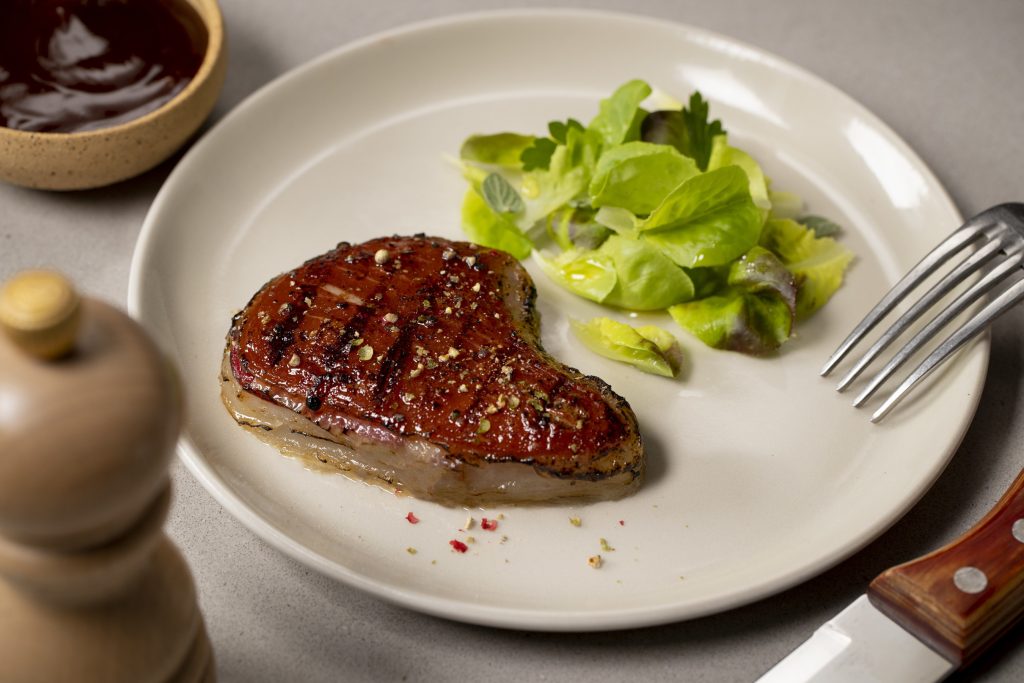 A 3.67 oz cultivated steak 3D printed by MeaTech. Photo via Shlomi Arbiv.
On the biomedical side, researchers have reported adevelopment in functional human tissue printing, using a photolithographic technique to generate mechanical and chemical cues that coax cells into organised, organ-like structures. Where that approach guides cells through printed physical signals, PRISM-LT delegates the guidance to living microbes inside the capsule, a biological route to the same goal of controlled tissue architecture.
The field keeps proving the same point: growing tissue is no longer the barrier. Steering it reliably, and clearing regulators, is. PRISM-LT’s contribution is a modular method that treats both problems as one.
3D Printing Industry is inviting speakers for its 2026 Additive Manufacturing Applications (AMA) series, covering Energy, Healthcare, Automotive and Mobility, Aerospace, Space and Defense, and Software. Each online event focuses on real production deployments, qualification, and supply chain integration. Practitioners interested in contributing can complete the call for speakers form here.
To stay up to date with the latest 3D printing news, don’t forget to subscribe to the 3D Printing Industry newsletter or follow us on LinkedIn.
Explore the full Future of 3D Printing and Executive Survey series from 3D Printing Industry, featuring perspectives from CEOs, engineers, and industry leaders on the industrialization of additive manufacturing, 3D printing industry trends 2026, qualification, supply chains, and additive manufacturing industry analysis.
Featured image shows 3D bioprinting close up. Photo via Philip Ezze, PRISM-LT.