Просмотр новости
Найдите то, что Вас интересует
 Спутники
 РН
РН SpaceX
 Роскосмос
 NASA
NASA
СпутникиРНSpaceXРоскосмосNASAThe US Food and Drug Administration (FDA) has granted premarket clearance to a 3D printed titanium cranial plate developed at Walter Reed National Military Medical Center, marking the first time the agency has cleared an implant produced by a point-of-care institution. The clearance, listed under submission number K253116, covers the 3D Medical Applications Center’s (3D…
The US Food and Drug Administration (FDA) has granted premarket clearance to a 3D printed titanium cranial plate developed at Walter Reed National Military Medical Center, marking the first time the agency has cleared an implant produced by a point-of-care institution.
The clearance, listed under submission number K253116, covers the 3D Medical Applications Center’s (3D MAC) Titanium Cranial Plate (TCP) System, developed with support from the Defense Health Agency (DHA) and 3D Systems.
The device is designed to reconstruct complex cranial and facial defects caused by trauma, disease, or cancer, and will be used to treat active-duty personnel and war fighters suffering traumatic head injuries around the world.
A design built for the operating room
Dr. Peter Liacouras, director of services at 3D MAC, designed the plate so that hardware doesn’t need to be added separately during surgery. “One feature of the TCP is that the fixation bars are already incorporated into the design, so you can simply place it and screw it down,” Liacouras said. For surgical teams treating combat injuries, that shortens a step in an already time-sensitive procedure.
3D MAC has built anatomical models, surgical guides, and implants for years, but those tools generally support surgical planning rather than becoming part of the patient, so they don’t require individual FDA sign-off the way an implant does. The TCP System is the center’s first product to undergo the full 510(k) process itself, with the center handling its production instead of relying on a physician-directed custom-device pathway or an outside manufacturer.
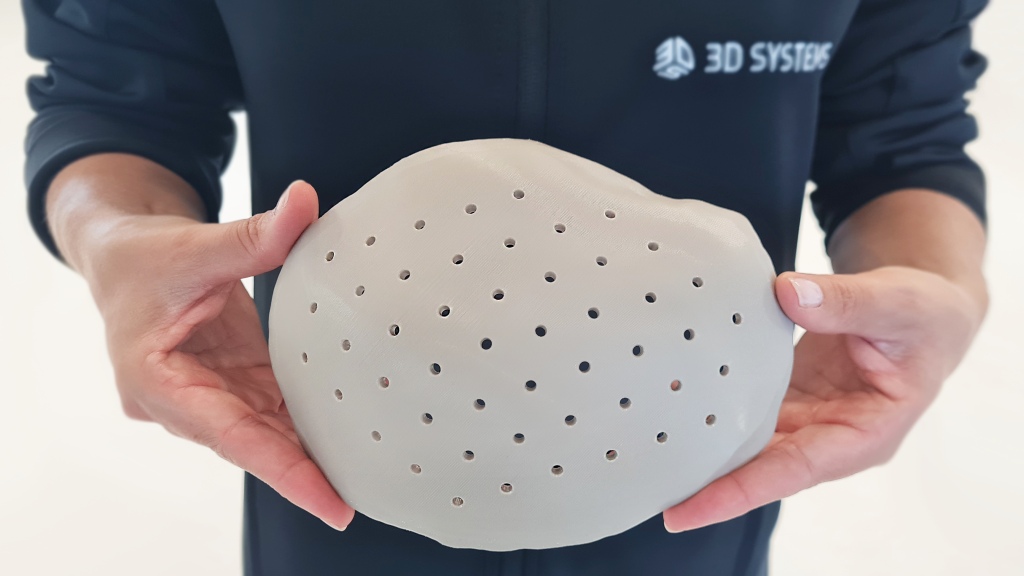
Dr. Peter Liacouras, director of services at 3D MAC, designed the 3D printed titanium cranial plate. Photo via Walter Reed National Military Medical Center.Building the regulatory track record
Reaching that bar took a multi-year effort. 3D Systems said it helped 3D MAC establish a quality management system and supported the project through design optimization, manufacturing process validation, and the submission itself.
“This clearance underscores the power of combining clinical innovation with deep expertise in additive manufacturing and regulatory compliance,” said Natalie Byrnes, 3D Systems’ manager of product development for patient-specific medical technology. “We are honored to help enable expanded access to personalized care delivered at the point of treatment.”
CEO Jeff Graves called the milestone validation of the company’s broader strategy: “We believe point-of-care manufacturing is transforming the future of healthcare by bringing personalized medical devices closer to the patient. Our unique collaborations with the U.S. Defense Health Agency and the Department of Veterans Affairs underscore our leadership in this space and reinforce our commitment to expanding this business as a long-term growth driver for 3D Systems.”
What it opens up for military hospitals
Because 3D MAC holds the 510(k) clearance itself, its design and manufacturing process can be used at other approved military treatment facilities beyond Walter Reed.
U.S. Army Lt. Col. Andrea Mountney, deputy director of the DHA’s Office of Regulatory Activities, said the approval speeds up how quickly wounded troops get custom hardware: “By securing 510(k) clearance for the 3D MAC Titanium Cranial Plate System, we are delivering personalized patient-unique implants at the point-of-care – accelerating casualty treatment, sharpening surgical outcomes and speeding the recovery of our wounded service members,” she said, adding that additive manufacturing “puts a critical capability directly into the hands of our military providers.”
From supplier-led to institution-led clearance
The Walter Reed result marks a shift in how 3D Systems has pursued point-of-care manufacturing. In earlier programs, the FDA or MDR clearance sat with a system 3D Systems had already cleared, and the hospital operated within it. Here, 3D MAC itself holds the clearance as the regulated manufacturer of record, a distinction that lets it expand the device to other sites.
That earlier model is visible in 3D Systems’ work with University Hospital Basel, where the company’s VSP PEEK Cranial Implant solution became the first cranial implant produced at the point of care under current MDR rules, followed in 2025 by what 3D Systems called the world’s first point-of-care facial implant. In both cases, the clearance belonged to 3D Systems’ own workflow, not the treating hospital.
 The VSP PEEK Cranial Implant is the first FDA-cleared, additively manufactured PEEK implant intended for cranioplasty procedures to restore defects in the skull. Photo via 3D Systems.
Other companies are approaching the same territory from different angles. Ricoh USA’s 3D for Healthcare Innovation Studio lets clinicians design and print FDA-cleared anatomic models on-site, and 3D LifePrints (now Insight Surgery) markets its EmbedMed platform directly to hospitals looking to stand up their own point-of-care 3D printing operations. None of these programs has yet put an implant through clearance under the treating institution’s own name.
That’s what makes the Walter Reed clearance significant. It shows a hospital lab can own FDA clearance outright, instead of borrowing it through a vendor’s system.
3D Printing Industry is inviting speakers for its 2026 Additive Manufacturing Applications (AMA) series, covering Energy, Healthcare, Automotive and Mobility, Aerospace, Space and Defense, and Software. Each online event focuses on real production deployments, qualification, and supply chain integration. Practitioners interested in contributing can complete the call for speakers form here.
To stay up to date with the latest 3D printing news, don’t forget to subscribe to the 3D Printing Industry newsletter or follow us on LinkedIn.
Explore the full Future of 3D Printing and Executive Survey series from 3D Printing Industry, featuring perspectives from CEOs, engineers, and industry leaders on the industrialization of additive manufacturing, 3D printing industry trends 2026, qualification, supply chains, and additive manufacturing industry analysis.
Featured image shows Dr. Peter Liacouras, director of services at 3D MAC, designed the 3D printed titanium cranial plate. Photo via Walter Reed National Military Medical Center.
| # | Наименование новости | Тональность | Информативность | Дата публикации |
|---|---|---|---|---|
| 1 | Улучшены титановые сплавы для биомедицины с помощью 3D-технологий | 0 | 0 | 08-07-2025 |
| 2 | Ухо с полимерными рёбрами: учёные выяснили как защитить имплантат от деформации | 1 | 8.05 | 10-08-2026 |
| 3 | В Свердловской области создали сплав для протезов и имплантов | 0 | 8.98 | 23-07-2026 |
| 4 | El Gregorio Marañón, primer hospital del mundo en fabricar e implantar una prótesis ósea de metamaterial personalizada | 0 | 4.33 | 14-08-2026 |
| 5 | Ухо с полимерными ребрами: как защитить имплантат от деформации | 0 | 9.11 | 10-08-2026 |
| 6 | Ученые смогли создать имплант уха, который прорастает сосудами и приживается | 0 | 7.54 | 10-08-2026 |
| 7 | Madrid Public Hospital Becomes a Certified Manufacturer of Medical Devices | 0 | 6.92 | 27-07-2026 |
| 8 | Создана система 3D-печати прототипов индивидуальных протезов | 0 | 0 | 02-05-2025 |
| 9 | Velo3D enters CRADA agreement with the US Army | 0 | 5 | 21-01-2026 |
| 10 | В России разработали новый сплав для протезов и имплантов | 0 | 10 | 23-07-2026 |