Просмотр новости
Найдите то, что Вас интересует
 Спутники
 РН
РН SpaceX
 Роскосмос
 NASA
NASA
СпутникиРНSpaceXРоскосмосNASASome of these predators were as long as whales. Roaming the seas more than 72 million years ago, the octopuses appear to have been the largest invertebrates ever known.
The kraken — a giant, tentacled sea monster that dragged ships into the depths — is a creature of Norwegian myth. But millions of years ago, a similar, real-life animal roamed the oceans, a new study finds.
The new analysis of jaw fossils suggests that as dinosaurs ruled the land, whale-sized octopuses ruled the seas. These super-sized cephalopods would have been the largest marine animals of the Late Cretaceous Period. That’s from about 66 million to 100 million years ago.
Researchers reported their findings April 23 in Science.
It’s difficult to study fossil octopuses, notes Yasuhiro Iba. He’s a paleontologist at Hokkaido University. That’s in Sapporo, Japan. With soft bodies, these animals tend to break down before becoming fossils. Very few hard parts remain to fossilize. Fortunately, both ancient and modern-day octopuses have a hard, beak-like jaw. This structure is made of chitin (KY-tin). This material is strong enough to survive the animal’s death and fossilize.
The jaws appeared to come from an octopus-like creature. But until now, details of the body size and animal’s role in the ocean ecosystem had been a mystery, Iba says.
A fresh look at old fossilsTo find those details, Iba was part of a team that examined 15 fossil jaws. Found in Japan and Canada’s Vancouver Island, they date to near the end of the age of dinosaurs.
Iba’s team took careful measurements. They also compared the mystery jaws to those from other species of octopus and squid. The team also found 12 jaw fossils embedded in rocks in Japan. Some were too fragile to dig out. So they examined them with a technique called digital fossil mining. It records fossils as detailed 3-D digital images.
To make these images, they ground down the rocks layer by layer. Each layer exposed a new bit of the fossils. The researchers then took photographs of each layer. Afterward, the team used these images — with some help from artificial intelligence — to make digital models of the fossils.
Researchers once thought these 27 cephalopods belonged to five extinct species. But as Iba and his colleagues learned more about them, they divided them into just two. There was Nanaimoteuthis jeletzkyi (Nuh-NY-moh-TOOTH-is Jeh-LETZ-skee-eye) and the much larger N. haggarti. The new analyses suggest the behemoths were early finned octopuses.
This group of deep-sea animals has webbing between their arms and flapping fins on the other end of their body. Finned octopuses still exist. One example is the dumbo octopus. The ancient ones were much, much larger.
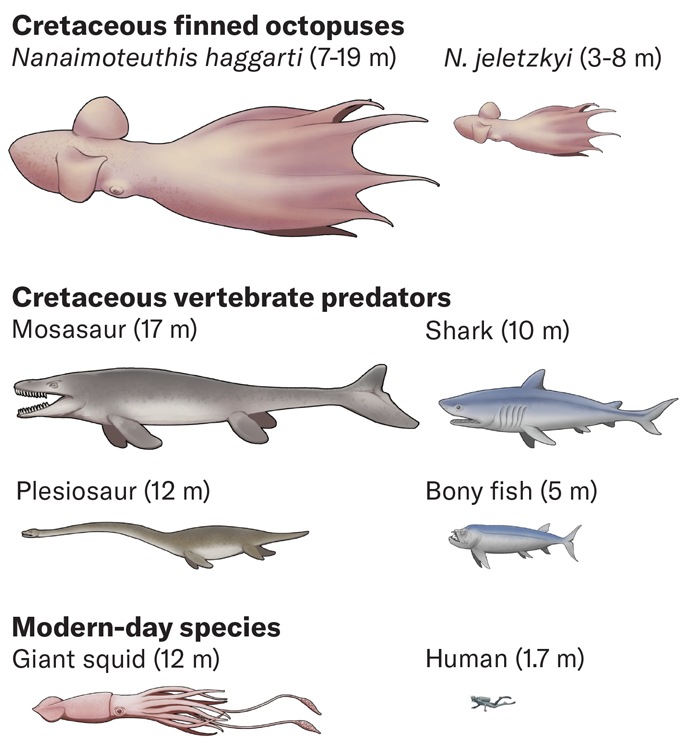
Perhaps the largest invertebrate ever known, the giant dinosaur-era octopus lived more than 72 million years ago. This predator dwarfed even the giant marine reptiles, such as plesiosaurs, not to mention today’s largest invertebrate, the giant squid.
 Hokkaido University
The largest lower jaw from an N. haggarti was big enough to hold a grapefruit. It also was about 50 percent bigger than that of the modern giant squid. At 12 meters (39 feet) long, that squid is one of the largest cephalopods alive today.
Iba estimates that N. haggarti could have spanned seven to 19 meters (23 to 63 feet) from its head to the tips of its arms. That’s between the length of an ambulance and a school bus.
The animal “may have been among the largest invertebrates in Earth’s history,” Iba now concludes.
No bones about itN. haggarti appears to have been bigger than even the largest ocean predators of its time. These would have included huge reptiles, such as mosasaurs and long-necked plesiosaurs.
Clues in the fossil jaws suggest the ancient giant octopuses competed with those top predators for a spot in the food chain. The researchers found wear and damage to the animals’ jaws. These scrapes and scuffs suggest the octopuses had been powerful predators. Biting on shells and bones likely roughed up their jaws.
That discovery seems to shed new light on ancient marine ecosystems. It suggests that a wider range of predators roamed the ancient seas than once thought.
“For a long time, the top of the marine food web has been thought to be dominated by large vertebrates,” Iba says. By mosasaurs and plesiosaurs, for example. “Our study shows that giant invertebrates — octopuses — also occupied that role in the Cretaceous,” he says.
It’s possible that Nanaimoteuthis was a bit smaller, notes Christian Klug. He’s a paleontologist at the University of Zurich, in Switzerland. The fossil remains are incomplete, he notes. Iba’s team used only the jaw fossils as it estimated total-body length.
Still, he says, “there is no doubt that these animals ranged among the top predators.” Future findings, he adds, may help pinpoint their roles in those ancient seas.
Paleontologist Adiël Klompmaker works at the University of Alabama in Tuscaloosa. He hopes some giant octopus fossils will turn up with well-preserved stomach contents. “That would tell us what they ate,” he says. Were they hunting shelled invertebrates, such as large ammonites? “Or did they also go after large vertebrates?”
Only time and more work by paleontologists will reveal such “kraken” secrets.
3-D: Short for three-dimensional. This term is an adjective for something that has features that can be described in three dimensions — height, width and length.
artificial intelligence: A type of knowledge-based decision-making exhibited by machines or computers. The term also refers to the field of study in which scientists try to create machines or computer software capable of intelligent behavior.
behemoth: A term for anything that is amazingly big. The term comes from a monstrous animal described in the Bible’s book of Job.
cephalopods: Ocean-dwelling animals that include squid and octopuses.
chitin: A tough, semi-transparent substance that is the main component of the exoskeletons of arthropods (such as insects). A carbohydrate, chitin also is found in the cell walls of some fungi and algae.
colleague: Someone who works with another; a co-worker or team member.
Cretaceous: A geologic time period that included the end of the Age of Dinosaurs. Spanning 145 million to 66 million years ago, it was a time when the whole planet had a relatively mild climate, with forests growing near both the North and South Poles. It marked the emergence of flowering plants and massive volcanic eruptions, which triggered big shifts in ocean ecosystems. And some regions cooled, leading dinosaurs there to adapt by evolving a coat of insulating feathers. Finally, it all came to an end 66 million years ago when a giant meteorite crashed into Earth, changing the global climate overnight. This wiped out all the dinosaurs (except those that would survive as birds), along with half of all plant and animal species.
digital: (in computer science and engineering) An adjective indicating that something has been developed numerically on a computer or on some other electronic device, based on a binary system (where all numbers are displayed using a series of only zeros and ones).
dinosaur: A term that means terrible lizard. These reptiles emerged around 243 million years ago. All descended from egg-laying reptiles known as archosaurs. Their descendants eventually split into two lines. For many decades, they have been distinguished by their hips. Many large dinosaurs died out around 66 million years ago. But some saurischians lived on. They are now the birds we see today.
ecosystem: A group of interacting living organisms — including microorganisms, plants and animals — and their physical environment within a particular climate. Examples include tropical reefs, rainforests, alpine meadows and polar tundra. The term can also be applied to elements that make up some artificial environment, such as a company, classroom or the internet.
extinct: (n. extinction) An adjective that describes a species for which there are no living members.
food web: (also known as a food chain) The network of relationships among organisms sharing an ecosystem. Member organisms depend on others within this network as a source of food.
fossil: Any preserved remains or traces of ancient life. There are many different types of fossils: The bones and other body parts of dinosaurs are called “body fossils.” Things like footprints are called “trace fossils.” Even specimens of dinosaur poop are fossils. The process of forming fossils is called fossilization.
invertebrate: An animal lacking a backbone. About 90 percent of animal species are invertebrates.
marine: Having to do with the ocean world or environment.
model: A simulation of a real-world event (usually using a computer) that has been developed to predict one or more likely outcomes. Or an individual that is meant to display how something would work in or look on others.
mosasaur: A type of extinct marine reptile that lived at the same time as dinosaurs.
octopus: (pl. octopi or octopuses) Sea mollusks with a soft, sac-shaped body and eight arms. Two rows of suckers along each arm give the animal an ability to grasp and hold onto things. Cousins of the squids, these animals have a sharp beak-like mouth and good vision.
paleontologist: A scientist who specializes in studying fossils, the remains of ancient organisms.
plesiosaur: A type of extinct marine reptile that lived at the same time as dinosaurs and is noted for having a very long neck.
predator: (adjective: predatory) A creature that preys on other animals for most or all of its food.
range: The full extent or distribution of something. For instance, a plant or animal’s range is the area over which it naturally exists.
reptile: Vertebrate animals belonging to a group known as Reptilia. Most reptiles have skin that is covered with scales or horny plates. Snakes, turtles, lizards and alligators are all reptiles. Once considered their own separate group, birds now belong to this order. With the exception of modern birds, most modern reptiles are cold-blooded (or ectothermic).
sea: An ocean (or region that is part of an ocean). Unlike lakes and streams, seawater — or ocean water — is salty.
shell: The normally hard, protective outer covering of something. It could cover a mollusk or crustacean (such as a mussel or crab), a bird’s egg or some other relatively soft tissue that needs protection (such as a tree nut or peanut).
species: A group of similar organisms capable of producing offspring that can survive and reproduce.
squid: A member of the cephalopod family (which also contains octopuses and cuttlefish). These predatory animals, which are not fish, contain eight arms, no bones, two tentacles that catch food and a defined head. The animal breathes through gills. It swims by expelling jets of water from beneath its head and then waving finlike tissue that is part of its mantle, a muscular organ. Like an octopus, it may mask its presence by releasing a cloud of “ink.”
About Jake Buehler
Jake Buehler is a freelance science writer, covering natural history, wildlife conservation and Earth's splendid biodiversity, from salamanders to sequoias. He has a master's degree in zoology from the University of Hawaii at Manoa.
| # | Наименование новости | Тональность | Информативность | Дата публикации |
|---|---|---|---|---|
| 1 | Giant octopuses ruled the oceans 100 million years ago, study finds | 0 | 11.29 | 25-04-2026 |
| 2 | Ancient fossil once thought octopus is actually nautilus: Study | 0 | 8.44 | 12-04-2026 |
| 3 | A coffee-table-size scorpion roamed Earth before forests existed | 0 | 17.49 | 02-09-2026 |
| 4 | Des pieuvres géantes régnaient sur les océans du Crétacé | 0 | 9.46 | 16-07-2026 |
| 5 | The world’s “oldest octopus” was never an octopus | 0 | 6.69 | 07-04-2026 |
| 6 | Adorable tiny blue octopus found nearly 6,000 feet beneath the Galápagos | 0 | 10.01 | 25-05-2026 |
| 7 | Millipedes beat vertebrates to land by 80 million years | 0 | 11.26 | 14-06-2026 |
| 8 | Ученые уточнили размеры мегалодона и ужаснулись | 0 | 7 | 30-06-2026 |
| 9 | Ученые уточнили размеры мегалодона и ужаснулись | 0 | 7 | 30-06-2026 |
| 10 | How squid survived Earth’s biggest extinction and took over the oceans | 0 | 13.83 | 01-04-2026 |