Просмотр новости
Найдите то, что Вас интересует
 Спутники
 РН
РН SpaceX
 Роскосмос
 NASA
NASA
СпутникиРНSpaceXРоскосмосNASASite adaptation has become the backbone of solar project finance and modern technical designs, according to Solargis' Martin Opatovsky.
The satellite-based solar model time series and local measurements are inextricably linked through site adaptation, a process that reduces data uncertainty and has become the backbone of solar project finance and modern technical designs.
Site adaptation of the model dataA decade ago, one of the most common ways to reconcile ground and satellite-based data was the simple Ratio Method. If your ground sensor showed 5% less sunlight than the satellite model over a one-year period, the entire 20-year satellite history was simply lowered by 5%.
This approach was simple, but it had important limitations. It assumed that the satellite model deviation was constant in all conditions, whether the sky was clear, hazy or overcast. In reality, satellite data might be highly accurate on a clear day but may show limitations in accounting for local atmospheric pollution, salt spray or specific cloud types during certain seasons.
The need to adapt the performance of solar models for the project site evolved in the concentrated solar power industry and was later applied to the PV industry. Solargis is one of the pioneers of this service and this method has also been shared within the scientific community.
Unlike some simple methods fixing the model output, the modern site adaptation tunes the underlying model inputs—such as aerosols and clouds. This ensures that the resulting Global Horizontal Irradiance (GHI) and Direct Normal Irradiance (DNI) are not only statistically accurate but also physically consistent with one another.
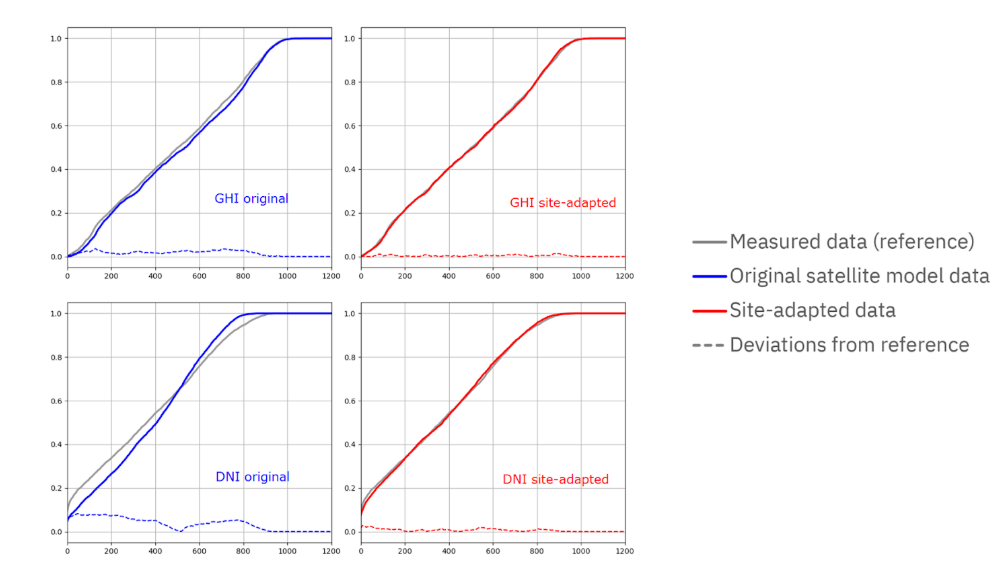 A comparison of original and site-adapted data. Image: Solargis.
Site adaptation and battery storage sizing
A comparison of original and site-adapted data. Image: Solargis.
Site adaptation and battery storage sizing
As the global energy transition shifts toward hybrid solar-plus-storage plants, the role of site adaptation is changing from a “yield enhancer” to a system optimiser.
For a solar PV power plant, even a 1% error in annual energy has financial relevance. Yet, besides reducing systematic deviation (described by the statistical measure called ‘bias’), the increased accuracy of instantaneous values (measured by ‘RMSD’) becomes more important.
For a battery energy storage system (BESS), the more realistic high-frequency data have a large impact, especially for critical weather events. Time series data with reduced uncertainty prevent overdesign (unnecessary capex), underperformance, system reliability issues or damage.
Capturing the real charging profileBatteries are not sized on annual averages; their design is based on the high-resolution time series, properly describing the daily solar patterns, including fluctuations and occurrence of solar ramps. Without site adaptation, engineers may overestimate the solar energy available during the peak 4-hour charging window.
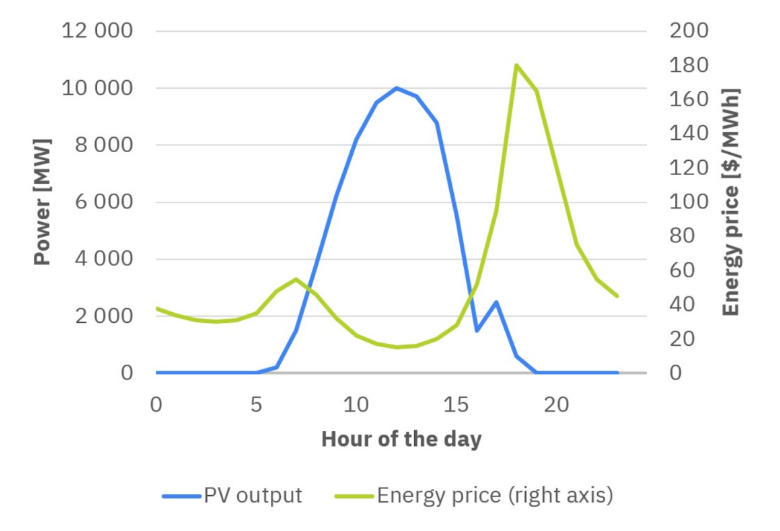 A comparison of PV output and energy price. Image: Solargis.
By using sophisticated methods that enhance the model inputs and internal characteristics of the time series data, site adaptation ensures the long-term record reflects the true frequency of intermittent clouds. This allows engineers to size the battery capacity with a better understanding of cloud variability.
Avoiding clipping uncertaintyIn many modern DC-coupled hybrid systems, the solar array is significantly oversized relative to the inverters (a high DC:AC ratio). Site adaptation improves understanding of how much the “extra” energy is clipped by inverters and how to account for it in battery sizing.
Reliability in extreme scenariosBattery storage is often deployed to provide power during the evening peak demand. Site adaptation enables a more accurate inter-annual variability analysis. It helps developers better understand the “worst-case” scenarios (successive days of low solar resource or occurrence of significant power ramps). By adapting the model data using the local solar measurements, we allow for more informed decisions on the battery size and system performance reliability.
The ground data crisis: why standards matterA dangerous misconception persists: that site adaptation is a purely mathematical exercise where measurements improve the model data. In reality, the process is only as reliable as the data fed into it.
To achieve the bankability required for PV hybrid systems, the industry must use the data from the best solar models and high-quality on-site measurements that have passed rigorous quality control. According to Solargis guidelines for ground measurements, three pillars are critical:
The move to 1-minute data is the final frontier in system optimisation. While 15-minute data is sufficient for long-term energy yield estimates, it is insufficient for understanding the technical performance of a PV system and its components. Only detailed solar irradiance time series can characterise high-frequency intermittency—as passing clouds cause significant power ramps.
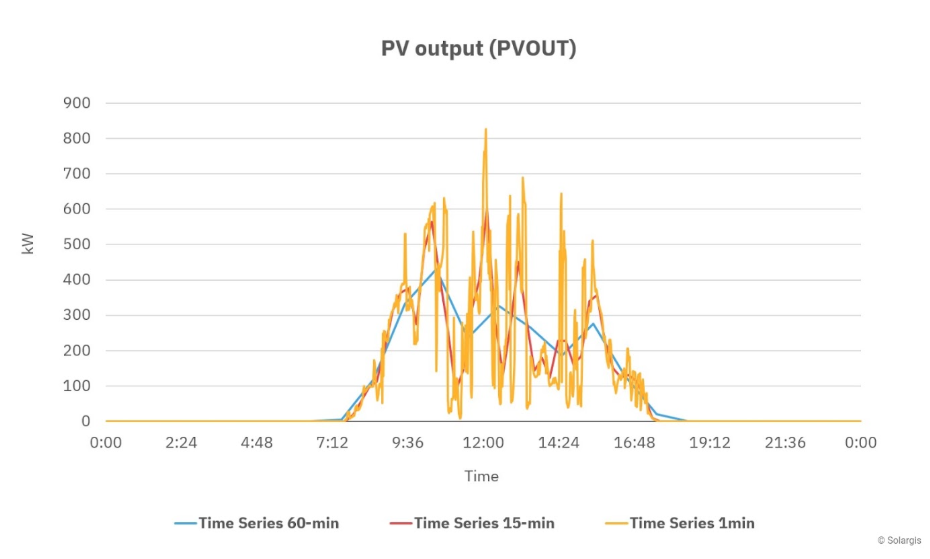 An illustration of the specificity of using 1-minute data. Image: Solargis.
Site adaptation of solar time series together with the use of a stochastic 1-minute data generation method provides the local “variability fingerprint” needed to simulate the behaviour of power electronics under high-variability cloud conditions. The 1-minute data resolution is essential for:
Site adaptation is the bridge that allows us to take a year of local measurements—validated by strict quality control—and turn it into thirty years of time series data with low uncertainty. For the modern developer, site adaptation of solar model data using local measurements is a standard practice to protect the technical integrity and financial models of complex PV hybrid assets.
Martin Opatovsky is a technical consultant and product manager at Solargis with a background spanning nuclear, oil & gas, battery storage and solar energy.