Просмотр новости
Найдите то, что Вас интересует
 Спутники
 РН
РН SpaceX
 Роскосмос
 NASA
NASA
СпутникиРНSpaceXРоскосмосNASAAn Air India A320 flying from Phuket to Delhi briefly lost hydraulic control across all three systems, causing the aircraft to plunge about 300 feet and injure 24 people. Airbus’ initial flight-recorder assessment found the pressure drop occurred within one second, briefly affecting the ailerons and elevators and leaving pilots struggling to control the aircraft.
Synopsis
An Air India A320 flying from Phuket to Delhi briefly lost hydraulic control across all three systems, causing the aircraft to plunge about 300 feet and injure 24 people. Airbus’ initial flight-recorder assessment found the pressure drop occurred within one second, briefly affecting the ailerons and elevators and leaving pilots struggling to control the aircraft.
 ET Bureau
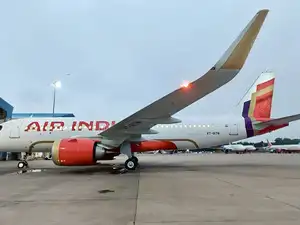
An Air India A320 briefly lost hydraulic control across all three systems, causing a rapid altitude drop that injured 24 people, with Airbus yet to determine whether it was an actual failure or a faulty sensor signal.
An Air India Airbus A320 that rapidly lost around 300 feet of altitude, injuring 24 people, briefly lost hydraulic control across all three of its independent systems, leaving pilots struggling for control for a few seconds, according to an initial assessment of the flight data recorders by Airbus, reviewed by ET.
Whether the hydraulics actually failed or it was a spurious warning caused by a faulty wire or sensor is yet to be ascertained. Airbus has asked Air India to physically check one of the hydraulic pressure switches to determine if it was faulty and sent a spurious signal.
Also read: Air India to stay on expansion course despite challenges
The incident has been termed "rarest of rare" by pilots and engineers familiar with the A320 and may invite scrutiny of one of the most widely used aircraft in the world. IndiGo and Air India together operate more than 500 A320 family aircraft, with around 1,300 on order. Airbus has not prescribed any pilot action for such a situation, as it considers it impossible.
While the captain is separately under scrutiny after testing non-negative for psychoactive substances, the initial assessment of the recorders does not indicate any human action as a cause of the incident.
The A320 has three independent hydraulic systems — colour-coded Green, Blue and Yellow — designed so that failure of one does not result in loss of aircraft control.
In the Air India plane, all three registered a pressure drop within one second, causing the elevators and ailerons to briefly stop responding to pilot commands.
The two ailerons, located on the outer parts of each wing, normally move in opposite directions — reducing lift on one side while increasing it on the other — to roll the aircraft left or right.
The elevators, on the horizontal tail at the rear, control the aircraft's nose up or down.
In this case, the ailerons moved in the same direction, generating extra lift that pushed the aircraft's nose upward steeply without any pilot input. The autopilot disengaged, as it is designed to do in abnormal conditions.
The first officer took manual control and pushed the nose down sharply, causing a rapid downward acceleration that threw passengers and cabin crew upward, leading to the injuries.
Five seconds later, pressure was restored across all three systems, the flight control computers reconnected and the aircraft began responding to pilot commands again.
The captain told the DGCA in his post-flight report that he was standing behind the first officer's seat discussing the aircraft's air conditioning system when the situation emerged. The pilots did not divert to the nearest airports — Varanasi or Lucknow — and continued to Delhi, around two hours away, despite reports of injuries on board.
The incident has been classified as a serious incident by the government and is being investigated by the Aircraft Accident Investigation Bureau (AAIB).