Просмотр новости
Найдите то, что Вас интересует
 Спутники
 РН
РН SpaceX
 Роскосмос
 NASA
NASA
СпутникиРНSpaceXРоскосмосNASAMoving to Madrid? More than just another Madrid expat guide, this practical checklist covers what every new student needs to know.
7 min read
Vibrant. Colorful. Historic. Welcoming. Madrid is a city that never stops evolving. Once known primarily as Spain’s political and cultural capital, it’s grown into the region’s most dynamic hubs for business, finance, innovation and entrepreneurship.

But the city has still managed to preserve the rich history, world-class museums and lively neighborhoods that make it an exciting place to call home. It’s no surprise that thousands of students from around the world choose to study in Madrid; they’re drawn by the opportunity to experience a new culture, build an international network and launch careers in one of Europe’s most connected cities.
If you’re one of them, you’re probably already getting everything ready for your relocation. But it can be a demanding process. From preparing the right documents to finding accommodation and understanding everyday life in Spain, a little preparation before moving to Spain can make the transition much smoother.
Before you leave home: which documents matter most?Preparation will start way before you ever leave home. In fact, this is one of the most critical periods; it’s when you formalize your university admission, secure travel documents, sort out health insurance and assemble other important documents.
1. Enrollment documentsOnce you receive a positive Admission Decision from IE University, you’ll receive your letter of acceptance via email, which will include all you need to make your Place Reservation Fee payment.
These confirmations will be essential when you apply for your student visa.
2. PassportMake sure your passport is valid before you travel. If it needs renewing, apply as early as possible because processing times can be longer than expected.
Exact requirements change depending on your nationality and visa type, but it’s a fairly common requirement that your passport is still valid for at least another six months when applying for a visa. Check the requirements that apply to your situation.
3. VisaAre you coming to Madrid for a short period, say to attend a residential week? If you plan to travel for less than 90 days, then you may need to obtain a tourist visa, depending on your nationality.
But if you’re reading this, you are probably moving to Madrid, Spain, for a longer period. This means you’ll likely have to apply for a student visa in your home country or country of residence.
This rule applies to non-EU nationals, even if you live in an EU country. Depending on your nationality, you might also need to apply for a Schengen visa for study purposes from your nearest Spanish consulate.
However, this can be a complex process and application requirements are prone to change. Reach out to our Student Services team to receive the most up-to-date guidance.

Before applying for a visa, you’ll need to obtain proof that you have complete health insurance coverage in Spain. Travel insurance doesn’t count.
5. Other important documentsEvery visa application is different, but typically you might need to present recent passport photos, proof of funds, a criminal record certificate, medical certificates and proof of accommodation.
Setting roots: finding accommodation in MadridMadrid is home to an eclectic range of barrios that offer a little something for everyone.
NeighborhoodsYou’ll find a variety of accommodation options in student-friendly neighborhoods such as:
– Chamartín
– Tetuan
– Moncloa
– Malasaña
– Centro, covering areas like Sol and La Latina
Chamartín is closest to IE Tower, while Centro is approximately 20 minutes away and likely to be among the most expensive choices due to its city-center location.
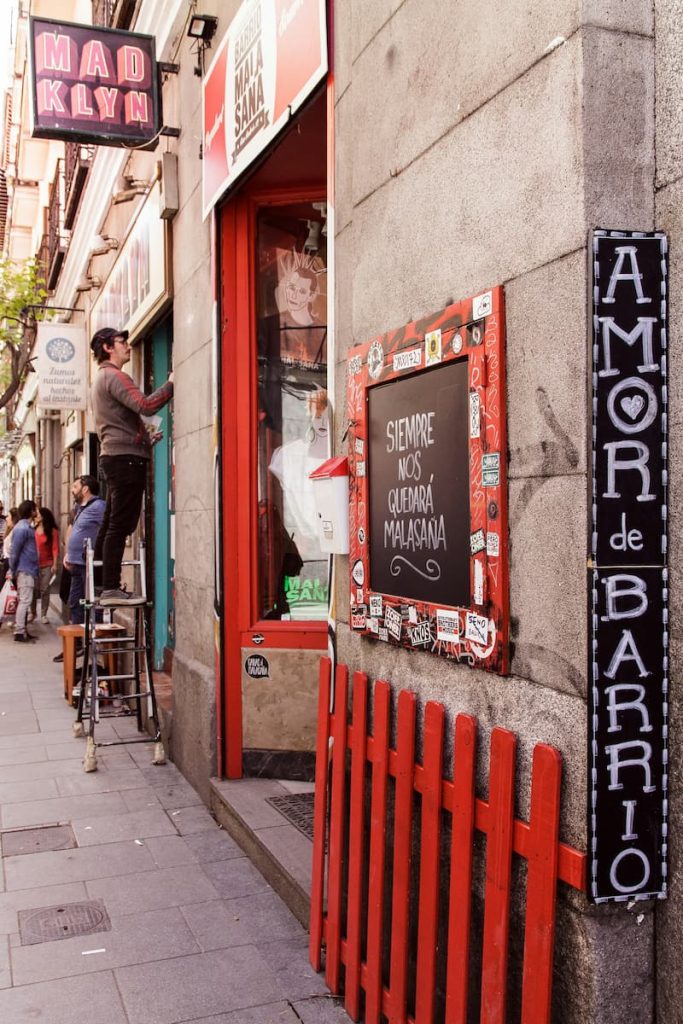
Each of Madrid’s barrios are unique, with their own rhythm, personality and cultural offerings. Try experiencing each one on your own, Madrid has something for everyone so that you’ll feel right at home.
Think about whether you want to stay in off-site student residences, shared homes or private apartments. While we don’t offer housing on campus, you still have plenty of options:
– Beyond Campus, our exclusive housing platform with trusted partners across Madrid.
– Student residences around the city, with whom we partner to offer safe, dedicated housing for bachelor’s and master’s students.
– Popular house search websites like Enalquiler and Idealista.
– Local real estate agencies such as DFLAT and Antoran Inmobiliaria.
Rent prices fluctuate across Madrid depending on the property’s location, size and specific amenities. On average, you can typically expect to spend the following for different types of residences:
– Private room: €600–700/month
– Student residence: From €785/month depending on the room type and location
– Studio apartment: Location dependent, varies considerably, but starting around €1,100/month
– One-bedroom apartment: €1,400/month centrally, less outside the center
Basic monthly utilities, including water, electricity, gas, trash collection, heating and cooling, can come to around €170. Additionally, expect to spend anywhere from €25 to €45 for high-speed broadband internet, plus around €15 monthly for a standard mobile plan. Then you’ve got to factor in things like eating out, gym, entertainment, transport and so on.
Of course, these prices are subject to change and will depend greatly on where and how you live. Always do your research before you make any financial commitments.
LeasesThe city’s real estate market features several unique quirks. If you’re planning on living in Madrid as a student, here’s what you should know:
– Many landlords will offer one-year contracts.
– A shorter contract might be negotiable, but you might have to pay more.
– Your landlord will probably ask for a security deposit equivalent to one or two months’ rent.
– They might also ask for other guarantees, such as a bank reference, proof of earnings or a guarantor’s signature, or an advance of one or two months’ rent.
– Rent prices don’t usually include utility costs in Spain.
A little due diligence could protect your finances and keep you from making costly mistakes:
– Don’t sign any lease or contract without a thorough review by you or your legal representative.
– Don’t pay rent unless you have a valid, signed leasing contract.
– Don’t pay any utilities, trash taxes or community fees unless they are explicitly defined in writing.
– Don’t pay agency fees. Under Spanish housing law, this is the landlord’s responsibility.
– Don’t pay a security deposit unless it’s duly registered by the landlord with regional authorities.
These easy tips could help you safeguard your finances and avoid common rental scams.
 Getting your NIE: why it’s the first thing you should do
Getting a NIE (Número de Identidad de Extranjero) is essential if you’re staying long term. Known as the Foreigner Identity Number in English, this unique, lifelong personal identification code is assigned by Spanish authorities for tax, legal and administrative purposes.
Get advice specific to your own nationality circumstances because the requirements for NIE applications very much depend on where you’re from, as well as how long you’re staying.
You’ll need to present your NIE Number, using your Tarjeta de Identidad de Extranjero ID card, to do everything from securing long-term housing to setting up utility bills, opening a bank account and registering for phone and internet services.
Follow up with Student Services as soon as you get on campus, and the team will guide you through the application process.
Opening a bank account and managing money in SpainWhile it’s not obligatory, most international learners opt to open a Spanish account while living in Madrid as students.
– You’ll need a valid NIE card to apply.
– We partner with two Spanish banks, Santander and Sabadell, to simplify the process.
As one of the most connected cities in the region, finding reliable public transportation in Madrid is surprisingly easy.
– You can take the metro to most destinations around the city.
– Ride the bus for €2.50 per trip.
– Take a local Cercanías commuter train. These run regularly between the city center and nearby towns.
– Rent a bike or buy one if you prefer to cycle through the city, although designated biking lanes are uncommon.
– Find a taxi in a pinch, although costs vary widely. The major ride-hailing apps are also active in Madrid.
– If you prefer to drive, an International Driving Permit is required. Remember that it’s only valid for six months.
You can use a pre-loaded Multi Card or Personal Public Transport Card if you plan to use the metro or public buses regularly. To stay on the safe side, always check route details and service times before any trip.

Meanwhile, historic Segovia is just a short train ride away; as little as 25 minutes on the express. You can also take a bus, which will naturally be a longer trip.
Life in Madrid is fast-paced, incredibly high-energy and fiercely social.
– The culture is passionate and artistic, rooted in community, and unexpectedly nocturnal: it’s not uncommon to find madrileños out close to midnight finishing up dinner.
– English is widely understood, but locals primarily speak Castilian Spanish. Don’t be surprised if you have to put your Spanish to use if you travel to more local neighborhoods or smaller towns throughout Spain.
– If you like people-watching or want to experience something new, there’s frequently something going on at a plaza or terraza around the city.

– Take a walking tour and discover Madrid’s iconic arts and culture scene in the city’s Golden Triangle of Art; the Reina Sofía, Thyssen-Bornemisza and Prado museums are only half a mile (a little under 1 km) apart.
– You might be used to eating early, but here, lunch usually happens between 2 p.m. and 4 p.m., while peak dinner time is around 9 or even 10 p.m.
– If you’re eating out, you usually won’t get la cuenta, the bill, until you ask for it. That’s because sitting around the table chatting after eating, known as sobremesa, is an important cultural norm here.
The Spanish capital is one of Europe’s most exciting cities to live in, but it pays to arrive prepared. While moving to Madrid might feel like a big step, it won’t be long before it feels like home. With a little groundwork and the support of IE University’s dedicated Student Services team, you’ll spend less time worrying about logistics and more time enjoying everything your new city—and your new university experience—has to offer.
From campus culture to living and studying in Madrid, explore everything IE University has to offer beyond the classroom.

Scott is editor-in-chief of Uncover IE and Senior Content Manager at IE University. He holds degrees in English Literature and Spanish from Saint Louis University and has spent more than a decade working in content strategy, editorial leadership, journalism and multilingual communications.
| # | Наименование новости | Тональность | Информативность | Дата публикации |
|---|---|---|---|---|
| 1 | Madrid excursions: Where to explore in Spain | 0 | 5 | 23-04-2026 |
| 2 | Avoid rental scams in Spain: A student safety checklist | 0 | 5 | 19-02-2026 |
| 3 | Where to eat in Madrid: Breakfast, lunch and dinner | 0 | 5 | 27-03-2026 |
| 4 | Guía útil para acudir al GP de España. | 0 | 10 | 05-05-2015 |
| 5 | Explainer: This is how to obtain Spanish nationality | 0 | 8 | 09-07-2026 |
| 6 | Luis Planas visita la Feria del Libro de Madrid | 0 | 10 | 06-03-2024 |
| 7 | Where to stay in Rioja: The guide that suits all budgets and desires | 0 | 7.9 | 21-07-2026 |
| 8 | Four seasons in Rioja: The essential to-do list no matter what time of year | 0 | 22.5 | 23-07-2026 |
| 9 | Manual para negociar: así puedes conseguir que te digan que sí sin ceder | 0 | 7.42 | 07-02-2026 |
| 10 | Cómo recorrer España a través de las vías verdes | 0 | 2.5 | 06-08-2026 |