Просмотр новости
Найдите то, что Вас интересует
 Спутники
 РН
РН SpaceX
 Роскосмос
 NASA
NASA
СпутникиРНSpaceXРоскосмосNASANearly six-in-ten U.S. adults are not confident that Trump can make good decisions about trade policy. Views of trade between the U.S. and China, Canada and Mexico have shifted since 2025.
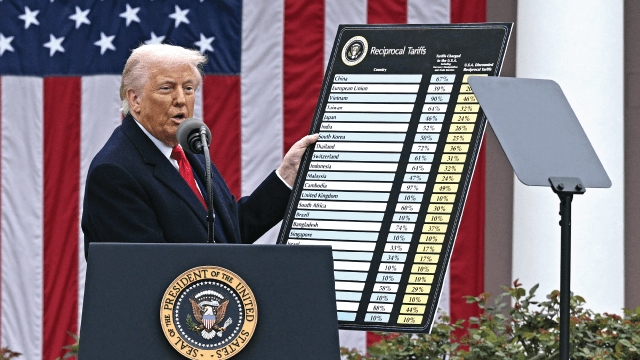 President Donald Trump delivers remarks on tariffs at the White House in Washington, D.C., on April 2, 2025. (Brendan Smialowski/AFP via Getty Images)
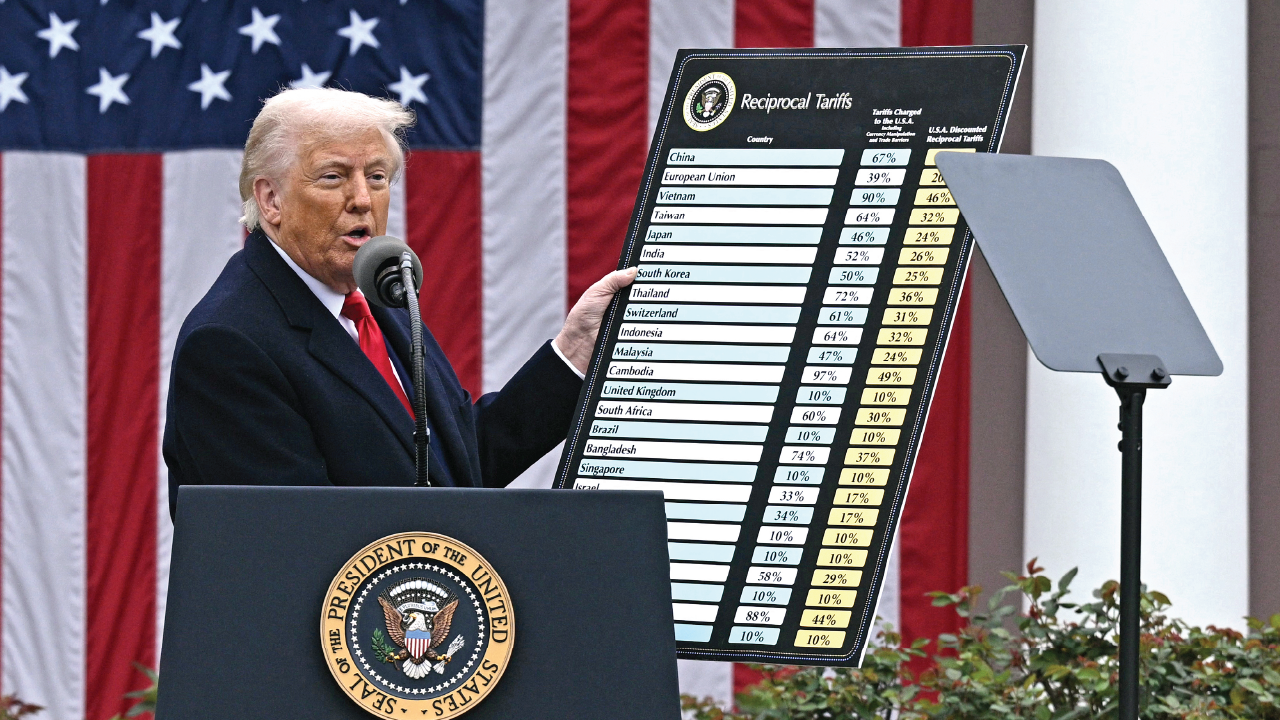
It’s been a year since President Donald Trump announced widespread tariffs on many U.S. trading partners, a move he billed as “Liberation Day.” Today, a majority of Americans are skeptical of his handling of the issue: Nearly six-in-ten adults (58%) are not too or not at all confident that Trump can make good decisions about U.S. trade policy, and 63% express little or no confidence in his handling of tariff policy, according to a new Pew Research Center survey.
The survey also shows that Americans’ attitudes toward trade relations with the United States’ top three trading partners – China, Canada and Mexico – have shifted somewhat since last year.
About this researchThis Pew Research Center analysis examines Americans’ attitudes toward U.S. trade policy, including relations with three key partners: China, Canada and Mexico.
Why did we do this?Pew Research Center does research to help the public, media and decision-makers understand important topics. This analysis builds on our previous work examining Americans’ views of U.S. trade with China, Canada and Mexico.
Learn more about Pew Research Center.
How did we do this?For this analysis, we surveyed 3,507 adults from March 23 to 29, 2026. Everyone who took part is a member of the Center’s American Trends Panel. The survey represents the views of the full U.S. adult population.
Here are the survey questions used for this analysis, the detailed responses and the survey methodology.
Data on trade between the U.S. and its major trading partners comes from the Census Bureau’s monthly report on international trade published March 12.
How Republicans and Democrats view Trump’s handling of trade and tariffsConfidence in Trump’s handling of U.S. trade and tariff policy differs by party and age.
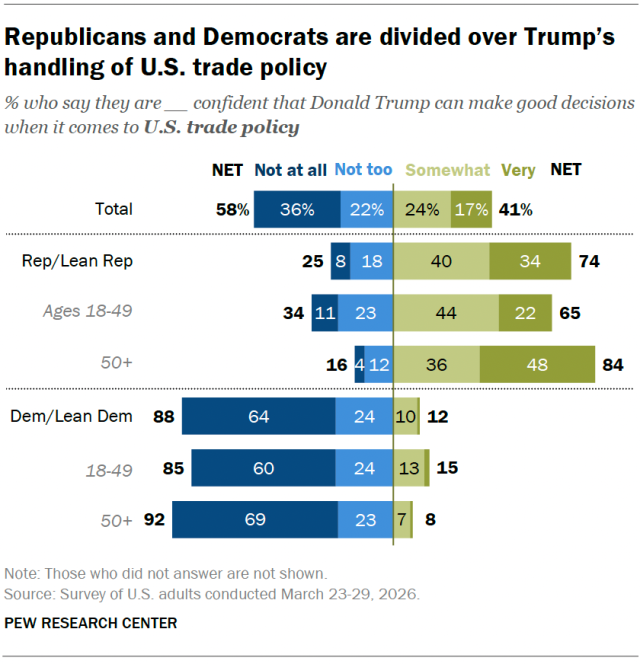
Republicans and Republican-leaning independents are about six times more likely than Democrats and Democratic leaners to express confidence that Trump can make good decisions on trade policy (74% vs. 12%).
Older Republicans and Democrats are furthest apart on this question: 84% of Republicans ages 50 and older are confident in Trump on this issue, including 48% who are very confident in him. By contrast, 92% of Democrats ages 50 and older are not confident in Trump’s handling of trade policy, including 69% who are not confident at all.
There are also partisan and demographic differences in views of Trump’s decision-making around tariff policy, which we asked about separately. For example, 66% of Republicans have confidence in Trump’s decisions on tariffs, while 91% of Democrats lack confidence. Across partisan and age groups, Americans are more skeptical of his ability to make good decisions about tariffs than his handling of trade.
Related: Americans largely disapprove of Trump’s tariff increases
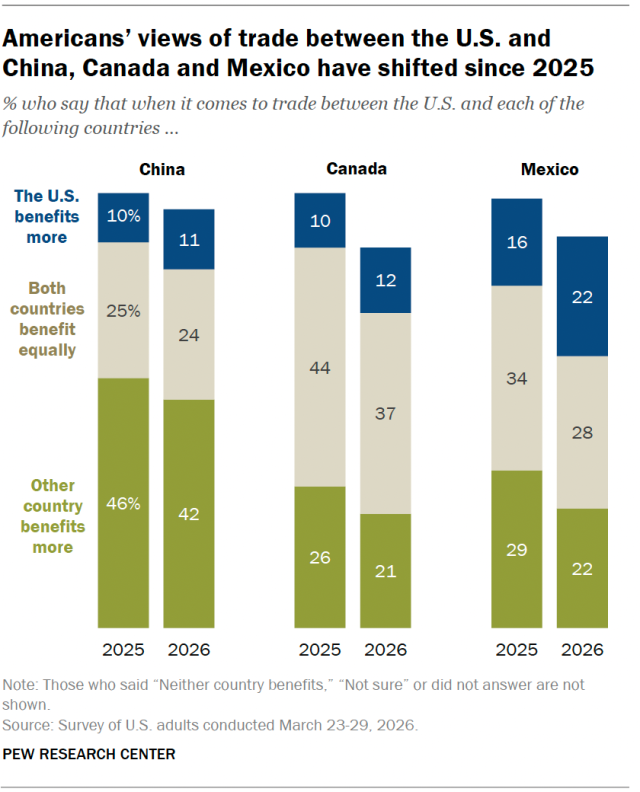
Views of U.S. trade with China, Canada and MexicoWe also asked Americans to evaluate the trade relationships between the U.S. and its top three international trading partners: China, Canada and Mexico.
Trade with China
Trade with Canada
Trade with Mexico
Republicans are generally more likely than Democrats to say that China, Canada and Mexico benefit more than the U.S. does in their respective trade relationships. Democrats, in turn, are more likely than Republicans to think both trade partners benefit equally. This mirrors partisan attitudes in 2025.
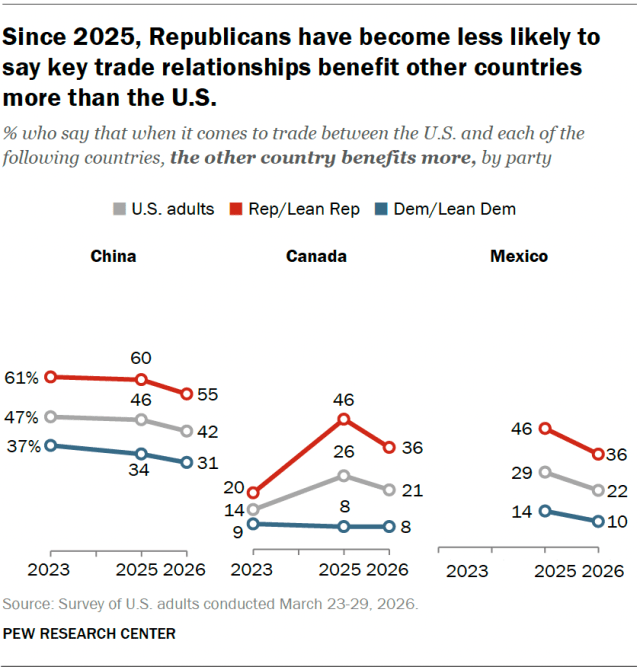
Since last year, however, Republicans have become less likely to say the other countries benefit more from trade with the U.S.
For example, 36% of Republicans now say Canada and Mexico benefit more than the U.S. does from their trade relationship, down from 46% who said this about each country last year.
This year, both Republicans and Democrats are less certain about which countries benefit more from trade, especially when it comes to relations in North America. When asked about U.S. trade with Canada, 22% of Republicans and 25% of Democrats say they are not sure which country benefits more, if at all – up from 16% each.
How much trade is there between the U.S. and its top trading partners?How trade deficits between the U.S. and key partners have changed since 2024
Figures on a balance-of-payments basis, in millions
Note: Figures are seasonally adjusted by geography.
Source: U.S. Census Bureau, “U.S. Trade in Goods and Services by Selected Countries and Areas, 1999-present” (Tables 1-9).
PEW RESEARCH CENTER
How trade deficits between the U.S. and key partners have changed since 2024
Figures on a balance-of-payments basis, in millions
| Year | Country | Exports – Goods | Exports – Services | Imports – Goods | Imports – Services |
|---|---|---|---|---|---|
| 2024 | China | $144,248 | $55,025 | $439,564 | $21,861 |
| 2024 | Canada | $350,409 | $90,267 | $419,666 | $57,035 |
| 2024 | Mexico | $334,436 | $50,415 | $515,587 | $45,136 |
| 2025 | China | $107,338 | $56,650 | $308,807 | $23,296 |
| 2025 | Canada | $336,866 | $89,552 | $390,144 | $60,685 |
| 2025 | Mexico | $338,337 | $52,395 | $541,353 | $44,021 |
Note: Figures are seasonally adjusted by geography.
Source: U.S. Census Bureau, “U.S. Trade in Goods and Services by Selected Countries and Areas, 1999-present” (Tables 1-9).
PEW RESEARCH CENTER
China, Canada and Mexico together accounted for 31.5% of all U.S. imports and 28.6% of all U.S. exports in 2025, according to data from the U.S. Census Bureau. But their status as major sources of imports to the U.S. – as well as leading destinations for American exports – has long complicated attempts to narrow the nation’s overall trade deficit. (A trade deficit occurs when imports exceed exports; when exports exceed imports, it’s a trade surplus.)
For decades, America’s largest bilateral trade deficit was with China. But in 2025, the deficit with Mexico eclipsed it for the first time this century:
All told, about $2.4 trillion in goods and services moved between the U.S. on one hand and China, Canada and Mexico on the other in 2025. That’s down from $2.5 trillion in 2024.
The total U.S. trade deficit rose $911.7 billion in 2025, compared with $903.5 billion in 2024. That means the U.S. imported almost $912 billion more in goods and services from other countries than it exported to them.
Note: Here are the survey questions used for this analysis, the detailed responses and the survey methodology.
| # | Наименование новости | Тональность | Информативность | Дата публикации |
|---|---|---|---|---|
| 1 | Majority of Americans take a dim view of increased trade with other countries | 0 | 6.39 | 29-07-2024 |
| 2 | Americans remain critical of Trump administration’s approach to Iran | 0 | 10.36 | 01-05-2026 |
| 3 | Canadians are fed up with Trump's tariffs and so are Americans as things get expensive | 0 | 6.31 | 27-07-2026 |
| 4 | Americans are divided on next steps for U.S. in Venezuela | 0 | 7.43 | 04-02-2026 |
| 5 | Большинство опрошенных считает, что Трамп не сделал Америку снова великой | 0 | 0 | 20-01-2021 |
| 6 | NPR/Chicago Council on Global Affairs/Ipsos poll: Americans oppose tariffs' economic impact; remain deeply wary of China's global ambitions | 0 | 7 | 12-05-2026 |
| 7 | Americans’ evaluations of the economy remain negative | 0 | 13.49 | 23-07-2026 |
| 8 | Большинство опрошенных американцев считают политику Трампа хаотичной и пугающей | 0 | 0 | 26-04-2025 |
| 9 | Canadians and Mexicans now view China more positively than the U.S. | 0 | 5.53 | 27-07-2026 |
| 10 | Опрос: американцы обеспокоены отношением Трампа к России | 0 | 0 | 31-01-2019 |