Просмотр новости
Найдите то, что Вас интересует
 Спутники
 РН
РН SpaceX
 Роскосмос
 NASA
NASA
СпутникиРНSpaceXРоскосмосNASA65% of Americans overall see clinical trials as very important, despite the time such trials add to the process of developing new treatments.
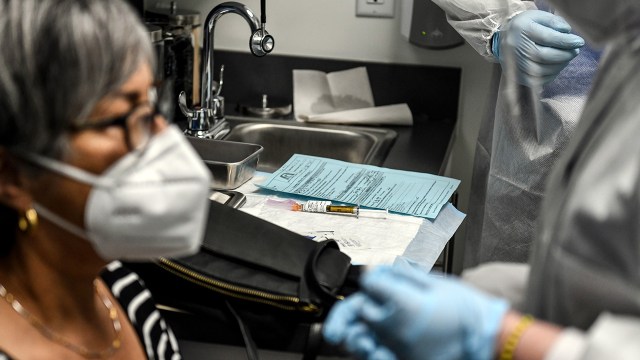 A participant in a phase three clinical trial receives a COVID-19 vaccine at the Research Centers of America in Hollywood, Florida, in August 2020. (Chandan Khanna/AFP via Getty Images)
The coronavirus outbreak has brought renewed attention to the clinical trial process, which is used to establish the safety and effectiveness of new treatments, such as COVID-19 vaccines.
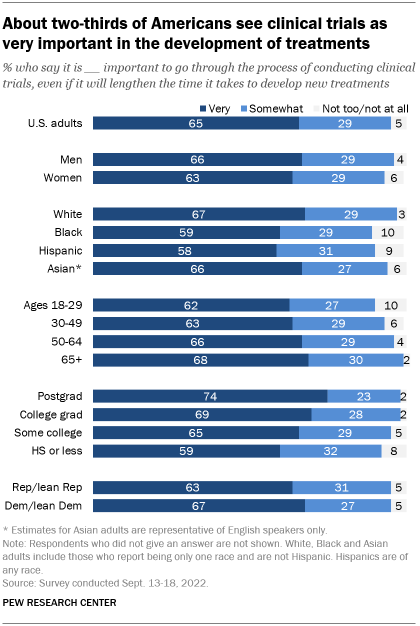
Overall, about two-thirds of U.S. adults (65%) see clinical trials as very important, despite the time such trials add to the process of developing new treatments, according to a recent Pew Research Center survey. Around three-in-ten (29%) see the clinical trial process as somewhat important, while 5% say it is not too or not at all important.
There is support for the role of clinical trials across demographic, educational and partisan groups. Majorities of Black (59%) and Hispanic adults (58%) say clinical trials are very important, as do slightly larger shares of White (67%) and English-speaking Asian adults (66%).
Pew Research Center conducted this study to understand Americans’ views about clinical trials. This analysis is based on a survey of 10,588 U.S. adults from Sept. 13-18, 2022. Everyone who took part in the survey is a member of the Center’s American Trends Panel (ATP), an online survey panel that is recruited through national, random sampling of residential addresses. This way, nearly all U.S. adults have a chance of selection. The survey is weighted to be representative of the U.S. adult population by gender, race, ethnicity, partisan affiliation, education and other categories. Read more about the ATP’s methodology.
Here are the survey questions used for this study, along with responses, and its methodology.
Focus group discussions were part of a broader Center research effort to better understand opinions about science and scientists among Black and Hispanic Americans. Six groups were held with Black adults (28 individuals in total) and six groups with Hispanic adults (29 individuals in all) from July 13-22, 2021. All focus group discussions were held virtually for 90 minutes with three to six participants in each group. Groups with Hispanic adults were conducted in English or Spanish. Group discussions were conducted by professional moderators using a guide developed by Pew Research Center. Center researchers systematically coded interview transcripts for thematic responses using qualitative data analysis software.
Here are the questions from the moderator guide and the focus group methodology.
The views of Black and Hispanic adults on this question are especially notable because these Americans were underrepresented in clinical trials for COVID-19 vaccines. Black and Hispanic participation in other kinds of clinical trials has often been too low to adequately assess whether new treatments are safe and effective across all racial and ethnic groups.
One factor in lower participation of Black and Hispanic adults in clinical trials is tied to concerns about past mistreatment in medical research, such as the U.S. Public Health Service Syphilis Study at Tuskegee or instances of medical doctors who sterilized racial and ethnic minority women without their full understanding.
A closer look at Black and Hispanic Americans’ viewsFocus group discussions conducted by Pew Research Center in July 2021 highlight the range of considerations that are top of mind for Black and Hispanic Americans when it comes to whether they personally would be willing to take part in a clinical trial.
Several participants talked about the desire to help others by participating in clinical trials, and some mentioned the potential benefits to help them with a medical condition of their own. Others talked about the possible benefit from financial compensation, especially at a time in life when finances were stretched.
Here are some examples of these perspectives shared by Black and Hispanic adults who took part in the Center’s focus groups:
At the same time, several focus group participants talked about balancing their desire to help others with wanting to protect themselves from potential harm. Some explained that they would not personally participate in a clinical trial because they felt there would be too much uncertainty or risk to their own health:
Some of those who spoke against participating in clinical trials focused on the notion of being a test case, especially given the past mistreatment of Black and Hispanic Americans in medical research:

Alison Spencer is a former research analyst focusing on science and society research at Pew Research Center.
Cary Funk is director of science and society research at Pew Research Center.
| # | Наименование новости | Тональность | Информативность | Дата публикации |
|---|---|---|---|---|
| 1 | Nearly half of Americans have used mental health medication, so why are 68% still hesitant? | 0 | 8.28 | 13-08-2026 |
| 2 | Опрос: большинство американцев поддерживает активное участие США в решении проблем мира | 0 | 0 | 30-09-2021 |
| 3 | Support for Israel less important to younger Jewish Americans: Survey | -2 | 6 | 13-07-2026 |
| 4 | Americans say keeping up with key news topics is crucial. But fewer say they’re highly informed themselves | 0 | 8.4 | 05-06-2026 |
| 5 | What Americans think about the global AI race | 0 | 9.17 | 23-07-2026 |
| 6 | Большинство избирателей США считает, что вакцина от COVID-19 разрабатывается поспешно | 0 | 0 | 06-09-2020 |
| 7 | Опрос: лишь половина американцев готовы сделать прививку от коронавируса | 0 | 0 | 13-10-2020 |
| 8 | Favorable views of Supreme Court remain near historic low | 0 | 6.29 | 30-07-2026 |
| 9 | Опрос: почти половина американцев выступает за импичмент Трампа | 0 | 0 | 04-07-2019 |
| 10 | Опрос показал, сколько американцев не одобряют работу Трампа | 0 | 11.02 | 29-07-2026 |