Просмотр новости
Найдите то, что Вас интересует
 Спутники
 РН
РН SpaceX
 Роскосмос
 NASA
NASA
СпутникиРНSpaceXРоскосмосNASAHendrik Verweij, who was for many years a driving force in the development of electronics for high-energy physics, passed away on 11 August 2025.
The post Hendrik Verweij 1931–2025 appeared first on CERN Courier.
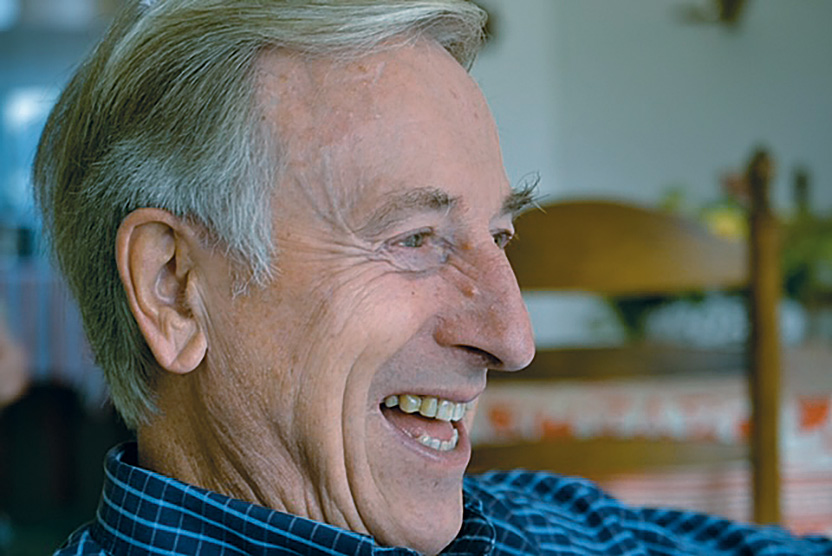 Henk Verweij was a great supporter of international standardisation and collaboration with industry. Credit: N Verweij-Marti
Hendrik Verweij, who was for many years a driving force in the development of electronics for high-energy physics, passed away on 11 August 2025 in Meyrin, Switzerland, at the age of 93.
Born in Linschoten near Gouda in the Netherlands, Henk earned a degree in electrical engineering at the Technical High School in Hilversum and started his career as an instrumentation specialist at Philips, working on oscilloscopes. He joined CERN in July 1956, bringing his expertise in electronics to the newly founded laboratory. With Ian Pizer, group leader of the electronics group of the nuclear-physics-division, he published CERN Yellow Report 61-15 on a nanosecond-sampling oscilloscope, followed by a paper on a fast amplifier one year later.
During the next four decades, developments in electronics profoundly transformed the world. Henk played a crucial role in bringing this transformation to CERN’s electronics instrumentation, and he eventually succeeded Pizer as group leader. Over the years he worked with numerous colleagues on fast signal-processing circuits. The creation of a collection of standardised modules facilitated the setup of a variety of CERN experiments. With Bjorn Hallgren and others, he realised the simultaneous, fast time and amplitude digitisation of the inner drift detector of the innovative UA1 experiment at CERN’s Super Proton Synchrotron, which discovered the W and Z bosons together with the UA2 experiment.
In the 1960s, recognising the importance of standardisation for engaging industry, Henk built close ties with colleagues in the US, including at Lawrence Berkeley Laboratory, SLAC and the National Bureau of Standards (NBS). He took part in the discussions that led to the Nuclear Instrumentation Module (NIM) standard, defined in 1964 by the US Atomic Energy Commission, and served on the NIM committee chaired by Lou Costrell of the NBS.
Henk was also a member of the ESONE committee for the CAMAC and later FASTBUS standards, working alongside colleagues such as Bob Dobinson, Fred Iselin, Phil Ponting, Peggie Rimmer, Tim Berners-Lee and many others from across Europe and the US in this international effort. He contributed hardware for standard modules both before and after the publication of the FASTBUS specification in 1984, and reported regularly at conferences on the status of European developments. A strong advocate of collaboration with industry, he also helped persuade LeCroy to establish a facility near CERN.
A driving force in the development of electronics for high-energy physics
Towards the end of his career, Henk became group leader of the microelectronics group at CERN, closing the loop in this transformational electronics evolution with integrated circuit developments for silicon microstrip, hybrid pixel and other detectors. When he retired in the 1990s, the group had built up the necessary expertise to design optimised application-specific integrated circuits (ASICs) for the LHC detectors. Ultimately, these allow the recording of millions of frames per second and event selection from the on-chip stored data.
Retirement did not diminish Henk’s interest in CERN and its electronics activities. He often passed by in the microelectronics group at CERN, regularly participating in Medipix meetings on the development of hybrid pixel-detector read-out chips for medical imaging and other applications.
Henk played an important role in making advances in microelectronics available to the high-energy physics community. His friends and colleagues will miss his experience, vision and irrepressible enthusiasm.
| # | Наименование новости | Тональность | Информативность | Дата публикации |
|---|---|---|---|---|
| 1 | Chen-Ning Yang 1922–2025 | 0 | 20.06 | 14-01-2026 |
| 2 | Michael Wohlmuther 1975–2025 | 0 | 16.28 | 02-06-2026 |
| 3 | Bernard Royce French 1931–2025 | 0 | 11.6 | 23-07-2026 |
| 4 | Erich Lohrmann 1931–2026 | 0 | 15.96 | 06-03-2026 |
| 5 | Matts Roos 1931–2025 | 0 | 15.63 | 06-03-2026 |
| 6 | Antonino Zichichi 1929–2026 | 0 | 15.14 | 06-03-2026 |
| 7 | Mark Alastair Rayner 1983–2026 | 0 | 12.8 | 02-06-2026 |
| 8 | Jan Żylicz 1932–2026 | 0 | 16.35 | 02-06-2026 |
| 9 | Marvin Marshak 1946–2026 | 0 | 14.49 | 23-07-2026 |
| 10 | mp3 pioneer and founding director of Fraunhofer IIS Professor Seitzer has passed away | 0 | 9.81 | 20-04-2026 |