Просмотр новости
Найдите то, что Вас интересует
 Спутники
 РН
РН SpaceX
 Роскосмос
 NASA
NASA
СпутникиРНSpaceXРоскосмосNASAThe LHCb collaboration reports its first dedicated searches for rare beauty-meson decays involving tau leptons.
The post Tau leptons join the hunt appeared first on CERN Courier.
A report from the LHCb experiment.
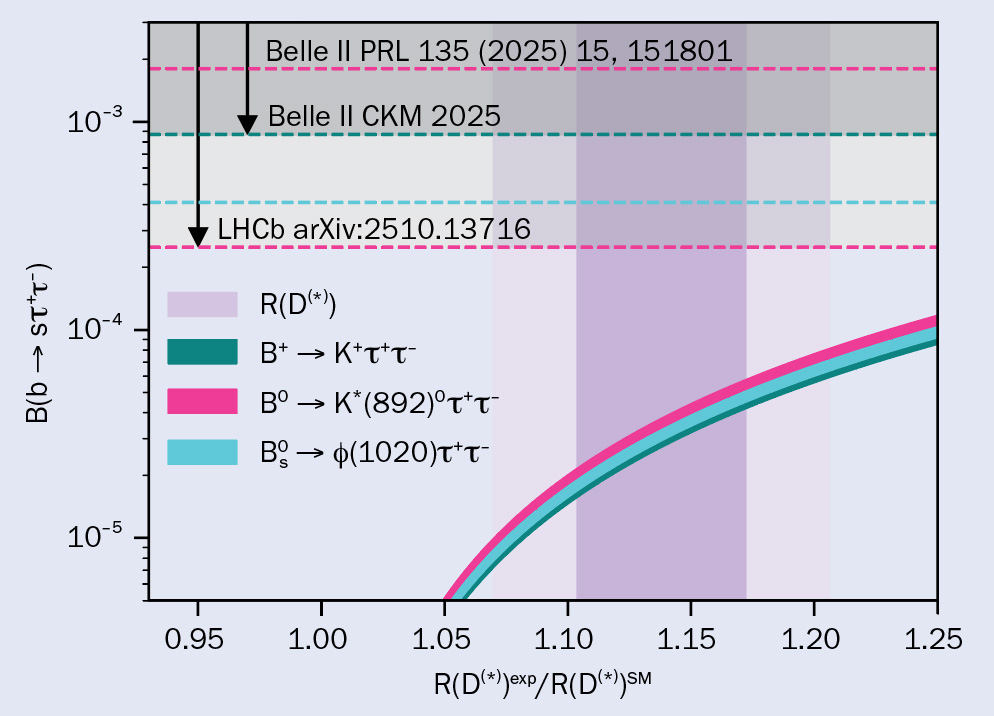 Fig. 1. The curves show the predicted branching fractions for three rare b → sτ+τ–decays as functions of the possible deviation in the ratios of semileptonic branching fractions R(D(*)) from the SM, based on the model proposed in PRL 120 (2018) 18180 and compared to the latest results from The Heavy Flavor Averaging Group (vertical bands). The horizontal lines indicate the upper limits at 90% confidence level from the LHCb and Belle II collaborations. Credit: LHCb Collab. 2025 arXiv:2510.13716
As the Standard Model (SM) withstands increasingly stringent experimental tests, rare decays remain a prime hunting ground for new physics. In a recent paper, the LHCb collaboration reports its first dedicated searches for the decays B0 → K+π–τ+τ– and Bs0 → K+K–τ+τ–, pushing hadron–collider flavour physics further into tau-rich territory.
At the quark level, the B0 → K+π–τ+τ– and Bs0 → K+K–τ+τ– decays happen via the flavour-changing process b → sτ+τ–, which is highly suppressed in the SM. The expected branching fractions of around 10–7 would place these decays well below the current experimental sensitivity. However, many new-physics scenarios, such as those involving leptoquarks or additional Z′ bosons, predict mediators that couple preferentially to third-generation leptons.
The tensions with the SM observed in the ratios of semileptonic branching fractions R(D(*)) and in b → sμ+μ– processes could, for example, result in an enhancement of b → sτ+τ– decays. Yet despite its potential to yield signs of new physics, the tau sector remains largely unexplored.
The LHCb analysis only considered tau decays to muons, in order to exploit the detector’s excellent muon identification systems. Reconstructing decays to final states with tau leptons at a hadron collider is notoriously challenging, particularly when relying on leptonic decays such as τ+ → μ+ντνμ, which result in multiple unreconstructed neutrinos. Using the Run 2 data set of about 5.4 fb–1 of proton–proton collisions, the collaboration applied machine-learning techniques to extract the topological and isolation features of suppressed tau-pair signals from the background.
Due to the large amount of missing energy in the final state, the B-meson mass cannot be fully reconstructed and the output of the machine-learning algorithm was instead fitted to search for a b → sτ+τ– component. The search was primarily limited by the size of the control samples used to constrain the background shapes – a limitation that will be alleviated by the larger datasets expected in future LHC runs.
No significant signal excess was observed in either the K+π–τ+τ– or the K+K–τ+τ– final states. Upper limits on the branching fractions were then established in bins of the dihadron invariant masses, allowing separate exploration of regions dominated by dihadron resonances and those expected to be primarily non-resonant.
These results represent the world’s most stringent limits on b → sτ+τ– transitions
When interpreted in terms of resonant modes, the limits are B(B0 → K*(892)0τ+τ–) < 2.8 × 10⁻⁴ and B(Bs0 → φ(1020)τ+τ–) < 4.7 × 10⁻⁴ at the 95% confidence level. The B0 → K*(892)0τ+τ– limit improves on previous bounds by approximately an order of magnitude, while the limit on Bs0 → φ(1020)τ+τ– is the first ever established.
These results represent the world’s most stringent limits on b → sτ+τ– transitions. The analysis lays essential groundwork for future searches, as the larger LHCb datasets from LHC Run 3 and beyond are expected to open a new frontier in measurements of rare b-hadron transitions involving heavy leptons.
With the upgraded detector and the novel fully software-based trigger, the efficiency in selecting low-pT muons – and consequently the tau leptons from which they originate – will be much improved. Sensitivity to b → sτ+τ– transitions is therefore expected to increase substantially in the coming years.
LHCb Collab. 2025 arXiv:2510.13716.
| # | Наименование новости | Тональность | Информативность | Дата публикации |
|---|---|---|---|---|
| 1 | Charm and beauty alike in fragmentation | 0 | 7.78 | 06-03-2026 |
| 2 | A sharper probe of a rare Bs decay | 0 | 5.75 | 02-06-2026 |
| 3 | A new doubly charmed baryon | 0 | 6.39 | 23-07-2026 |
| 4 | W boson decays to three charged hadrons | 0 | 6.56 | 23-07-2026 |
| 5 | The flavour dependence of jet structures | 0 | 8.71 | 06-03-2026 |
| 6 | Two channels for the top–antitop excess | 0 | 10.74 | 02-06-2026 |
| 7 | Trigger-level search for dijet resonances | 0 | 16.83 | 14-01-2026 |
| 8 | The many flavours of LHCb | 0 | 15.06 | 14-01-2026 |
| 9 | The most elusive higgsinos | 0 | 9.87 | 06-03-2026 |
| 10 | Alchemy by pure light | 0 | 8.48 | 07-11-2025 |