Просмотр новости
Найдите то, что Вас интересует
 Спутники
 РН
РН SpaceX
 Роскосмос
 NASA
NASA
СпутникиРНSpaceXРоскосмосNASAThe 25th Zimányi Winter School gathered 120 researchers in Budapest to discuss recent advances in medium- and high-energy nuclear physics.
The post Budapest brims with heavy ions appeared first on CERN Courier.
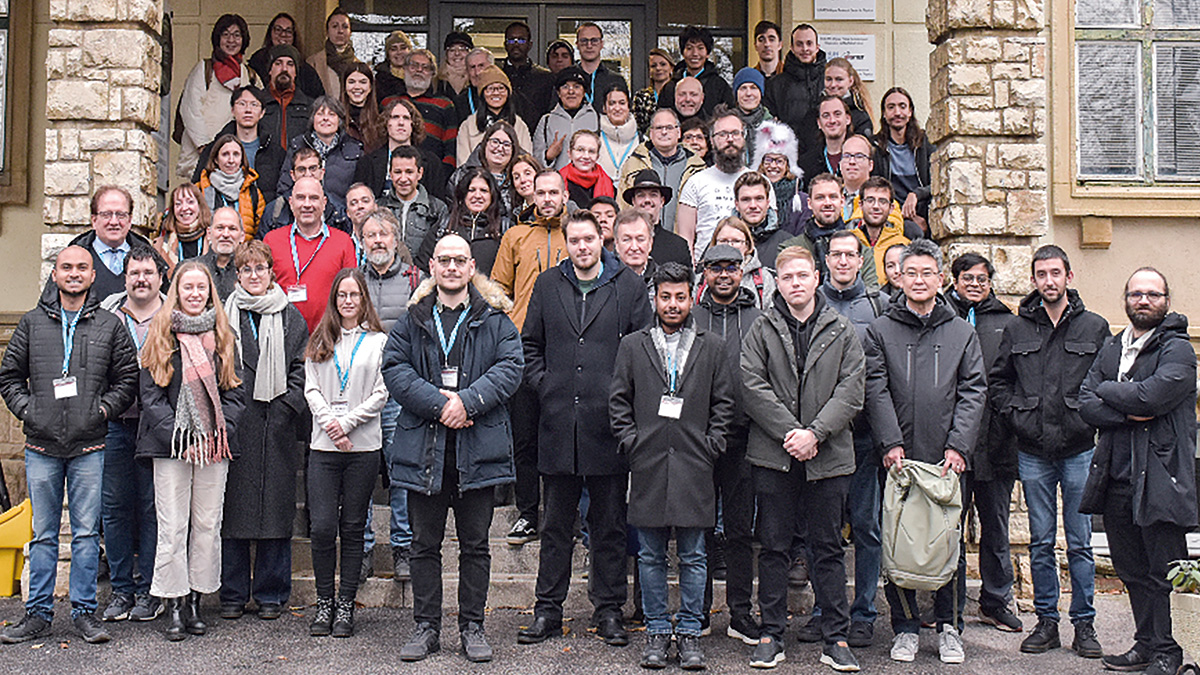 Expanding systems The 25th Zimányi Winter School was jointly organised by the Institute for Particle and Nuclear Physics of the HUN-REN Wigner Research Centre for Physics and the Institute of Physics at Eötvös Loránd University. Credit: HUN-REN Wigner Research Centre for Physics
The 25th Zimányi Winter School gathered 120 researchers in Budapest to discuss recent advances in medium- and high-energy nuclear physics. The programme focused on the properties of strongly-interacting matter produced in heavy-ion collisions – little bangs that recreate conditions a few microseconds after the Big Bang.
József Zimányi was a pioneer of Hungarian and international heavy-ion physics, playing a central role in establishing relativistic heavy-ion research in Hungary and contributing key developments to hydrodynamic descriptions of nuclear collisions. Much of the week’s programme revisited the problems that occupied his career, including how the hot, dense system created in a collision evolves and how it converts its energy into the observed hadrons.
Giuseppe Verde (INFN Catania) and Máté Csanád (ELTE) emphasised the role of femtoscopic methods, rooted in the Hanbury Brown–Twiss interferometry originally developed for stellar measurements, in understanding the system that emerges from heavy-ion collisions. Quantum entanglement in high-energy nuclear collisions – a subject closely connected to the 2025 Nobel Prize in Physics – was also explored in a dedicated, invited lecture by Dmitri Kharzeev (Stony Brook University), who described the approach and the results of his team that suggest the origin of the observed thermodynamic properties is quantum entanglement itself.
The NA61/SHINE collaboration reported ongoing studies of isospin-symmetry breaking, including a recent result where the charged-to-neutral kaon ratio in argon–scandium collisions deviates at 4.7σ from expectations based on approximate isospin symmetry (CERN Courier March/April 2025 p9). Further detailed studies are planned, with potential implications for improving the understanding of antimatter production.
Hydrodynamic modelling remains one of the most successful tools in heavy-ion physics. Tetsufumi Hirano (Sophia University, Japan), the first recipient of the Zimányi Medal, discussed how the collision system behaves like an expanding relativistic fluid, whose collective motion encodes its initial conditions and transport properties. Hydrodynamic approaches incorporating spin effects – and the resulting polarisation effects in heavy-ion collisions – were discussed by Wojciech Florkowski (Jagiellonian University) and Victor E Ambrus (West University of Timisoara).
| # | Наименование новости | Тональность | Информативность | Дата публикации |
|---|---|---|---|---|
| 1 | Vienna’s new hub for particle physics | 0 | 12.47 | 14-01-2026 |
| 2 | The age of the blockbuster-scale radiopharmaceutical | 0 | 11.89 | 02-06-2026 |
| 3 | Suppression grows with system size | 0 | 12.34 | 06-03-2026 |
| 4 | Quarkonium experts regroup at CERN | 0 | 14.62 | 06-03-2026 |
| 5 | New directions for bent crystals | 0 | 13.6 | 06-03-2026 |
| 6 | A sharper probe of a rare Bs decay | 0 | 5.75 | 02-06-2026 |
| 7 | Physics labs under the lens | 0 | 11.57 | 06-03-2026 |
| 8 | Európa elit egyetemein sincs jobb kvantumlabor, mint a BME-n | 0 | 18.86 | 29-07-2026 |
| 9 | Kapitány István: mindenkinek köszönöm! | 5 | 5 | 02-07-2026 |