Просмотр новости
Найдите то, что Вас интересует
 Спутники
 РН
РН SpaceX
 Роскосмос
 NASA
NASA
СпутникиРНSpaceXРоскосмосNASA"The great advantage of Antarctica is that one never gets ill," said Robert Scott. A lot can change in 100 years, and H5N1 is devastating the peninsula.
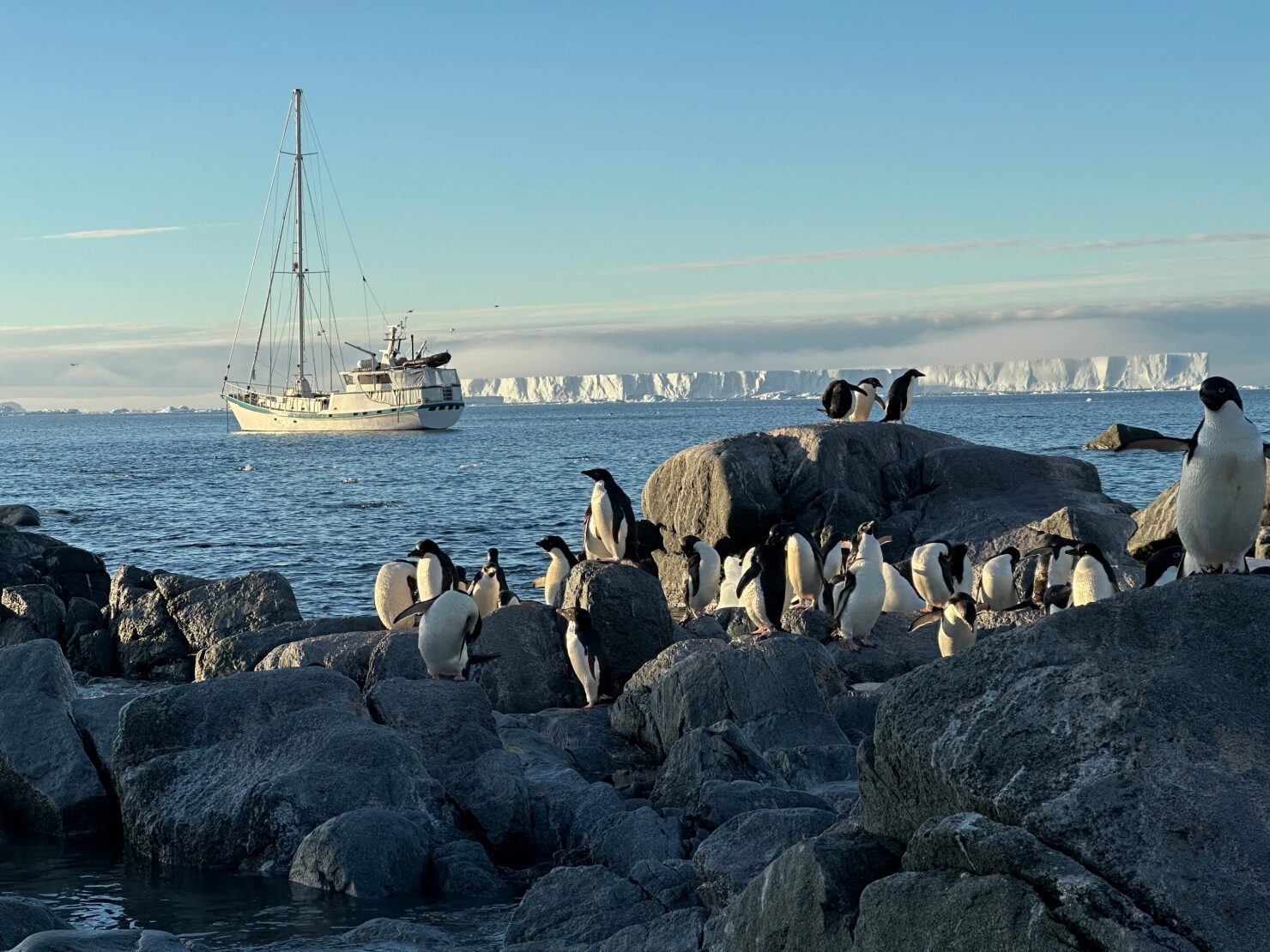 The yacht 'Australis' in Antarctic waters. Photo: Antonio Alcami (CBMSO)
Disease tops nobody’s list of Antarctic dangers. “The great advantage of this place is that one never gets ill,” said Robert Falcon Scott. His contemporary, Douglas Mawson, even suggested that the icy continent would be an ideal place for tuberculosis sufferers to recover due to the lack of germs.
A lot can change in a hundred years.
Deadly new strainIt’s been over five years since a new, deadly strain of Avian flu, called HPAI H5N1 clade 2.3.4.4b, began decimating global bird populations. There have been significant outbreaks in the UK, Europe, South Africa, and the Americas. The disease targets not only birds but also pinnipeds like seals, walruses, and sea lions. Last year, it finally landed on the Antarctic Peninsula.
But scientists could do nothing, not even monitor the situation. During the long, black winter, they were unable to study the progress of the disease. As soon as conditions allowed, a research team about the Australis crossed the Drake Passage into Antarctic waters. They were led by Spanish virologist Antonio Alcamí, who had identified the first case a year earlier.
The ship, equipped with a state-of-the-art lab, visited dozens of sites along the peninsula’s coast and in the Weddell Sea. What they found wasn’t encouraging.

Researchers from an earlier expedition, funded by the International Association of Antarctica Tour Operators (IAATO), found dead and dying skua gulls. Photo: CC BY-SA, Ben Wallis
In total, they collected and tested 846 samples, and 188 tested positive for H5N1. The infected animals were from nine bird and four seal species. The animals they tested had a high viral load, making them highly infectious to other animals around them. Carcasses, especially, are a vector, and because of this the skua, a carrion-bird, has been especially hard hit.
The disease has spread geographically, too. The virus was present in 24 out of 27 sites they visited, ranging down the arm of the peninsula and across various Antarctic and subantarctic islands, including South Georgia. The older infections were on the north side of the peninsula, where visitors observed lower populations, especially of the skuas. On the south side, the outbreak is more recent, and visitors can see dead and dying seabirds.
No infections have been confirmed on the Antarctic continent beyond the peninsula, but that doesn’t mean H5N1 isn’t there. Researchers have already observed unusual mortality among bird populations further east along the Princess Astrid Coast.
Along with the skua, crab-eater seals have been particularly affected by recent outbreaks. On Joinville island, where crab-eaters are common, the local population was devastated.
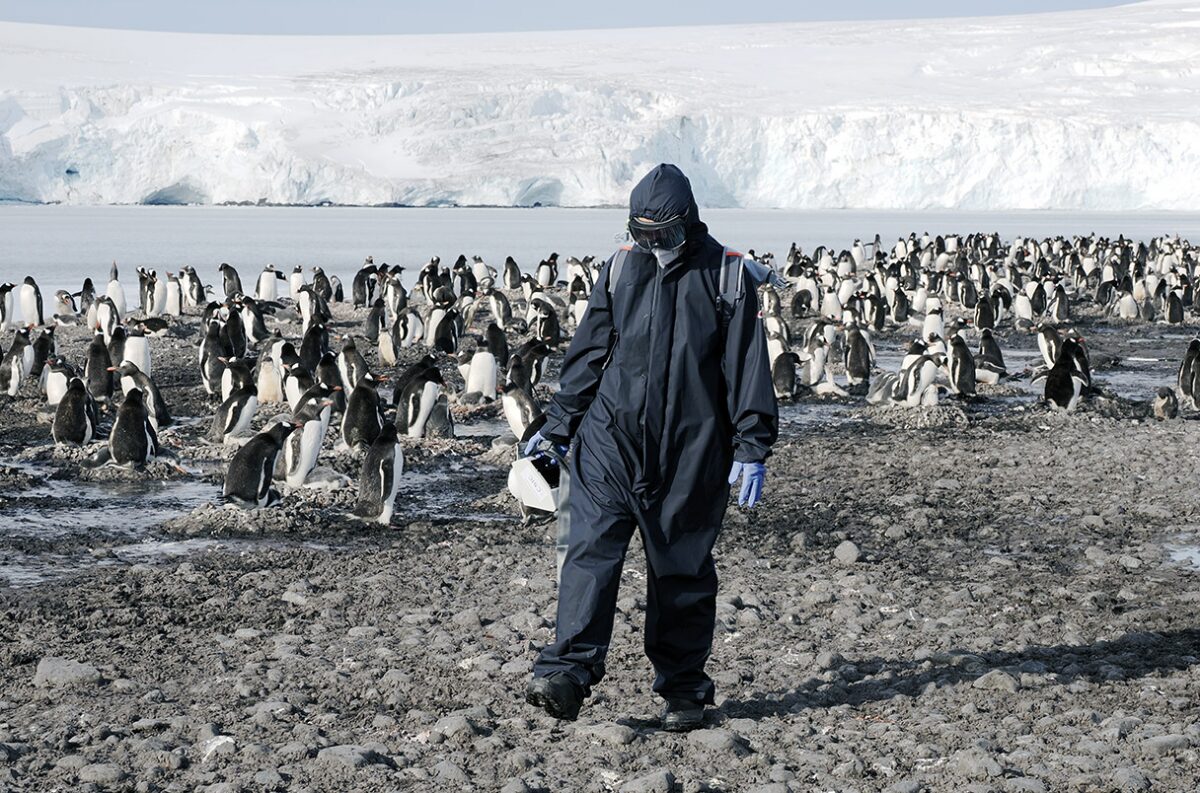
On Joinville Island; the Gentoo penguins, pictured, were relatively unscathed, but crab-eater seals were not so lucky. Photo: Antonio Alcami (CBMSO)
One animal that hasn’t been dying off is penguins. Both Adelie and Gentoo penguins have tested positive for the virus, but many infected individuals appear healthy. The virus is so thick in the air at their colonies that the researchers detected it using an air pump.
There were some suspicious penguin die-offs last year, which researchers think may have given the surviving birds immunity.
This is good news for penguins but presents a substantial risk to human visitors. Avian flu can infect humans who come in contact with infected birds. Of all Antarctic birds, the cute and friendly penguin is most likely to approach, or be approached, by humans.
The Scientific Committee on Antarctic Research (SCAR) established the Antarctic Wildlife Health Network database to monitor the spread. According to SCAR President Yeadong Kim, they are “deeply concerned with the evolving situation” in Antarctica.
With the fall of Antarctica, Australia is now the only uninfected continent.
| # | Наименование новости | Тональность | Информативность | Дата публикации |
|---|---|---|---|---|
| 1 | Все птицы Антарктиды могут погибнуть – ученые | -5 | 7 | 18-02-2026 |
| 2 | H5N1 bird flu kills more than 50 skuas in first Antarctica wildlife die off | 0 | 9.92 | 12-02-2026 |
| 3 | How Life-Threatening Altitude Sickness Struck Down a Worker in Antarctica | 0 | 10.39 | 13-02-2026 |
| 4 | Часть вторая. Антарктида. Сначала самые свежие новости об Антарктиде, которые ... | -2 | 7 | 28-06-2026 |
| 5 | What Antarctic Sled Expeditions Teach Us About the Human Body | 0 | 5.41 | 11-09-2025 |
| 6 | Antarctic Season Starts Soon; Here's What Happened Last Year | 0 | 6.69 | 28-10-2025 |
| 7 | New Funding Cuts Forcing U.S. Researchers Out of Antarctica | 0 | 7.43 | 15-04-2025 |
| 8 | Five more cases of deadly bird flu confirmed in Australia | -2 | 6 | 10-07-2026 |
| 9 | Fossil found in drawer turns out to be first dinosaur bone from Antarctica | 5 | 7 | 30-06-2026 |
| 10 | First suspected H5N1 bird flu case in NSW, as state ramps up surveillance | 0 | 6 | 03-07-2026 |