Просмотр новости
Найдите то, что Вас интересует
 Спутники
 РН
РН SpaceX
 Роскосмос
 NASA
NASA
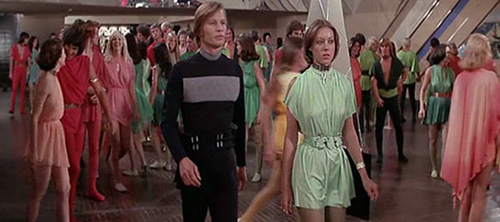
СпутникиРНSpaceXРоскосмосNASA(1) WE’RE A LITTLE LATE, FOLKS. The author of Muse from the Orb confesses “I Finally Watched… LOGAN’S RUN (1976)” and tells what they thought of it. …Though no one knew it in 1976, Logan’s Run was probably the last great sci-fi … Continue reading →
(1) WE’RE A LITTLE LATE, FOLKS. The author of Muse from the Orb confesses “I Finally Watched… LOGAN’S RUN (1976)” and tells what they thought of it.
…Though no one knew it in 1976, Logan’s Run was probably the last great sci-fi movie of the the “tinsel/synthesizer” era — camp, fun, brightly-lit movies where production design communicated THE FUTURE with shiny interiors, rainbow colors, boop-zoop sounds, and (in the case of Zardoz and Barbarella) sets that were sometimes literally just tinsel. In the Hollywood imagination from 1968-1977, it was expected that the third millennium would look like The Cher Show, or that Peter Brook production of A Midsummer Night’s Dream but with even more multicolored robes, wires, and tubes that made cool space sounds.
Logan’s Run is a capstone for this era, a fantastic high note on which the tinsel age would unwittingly end. No movie has done mirrors, neon, or that “extremely shiny airport” type of futurism better — every woman gets her own Sabrina Carpenter wardrobe, and you shuttle from environ to environ in little bubble domes like it’s Epcot. Farrah Fawcett’s cameo as a medspa beautician is spot-on — her signature smile, flirtatious and innocent but weirdly sinister in its perfection, makes her the perfect symbol for this youth-obsessed world where an entire population’s energy is channeled into consumption and frivolity….
… My favorite parts of the movie are background details that hint at the larger history and worldbuilding of the Dome — certain sectors have been allowed to fall into disrepair, and we see flashes of old signs on the walls. It makes the universe feel much bigger, the story of the Dome much deeper — what happened? Was the Dome’s population larger in a past age? What calculations does the Computer make about its maintenance? In terms of tasty mysteries, the best scene is the goofy encounter Logan and Jessica have with a robot far underground. He lives in an icy cave and has clearly gone insane over the centuries, but every line and detail hints at some larger narrative: He declares himself some sort of “fusion” of man and machine and reveals a ghastly hallway where stores the frozen bodies of Runners, because the “other food” — plankton and protein — “stopped coming.” Was he human once? Does he predate the Dome? Is he lying about the plankton and protein — did the pre-Dome society try to fix its overpopulation problem with cannibalism, in secret cryochambers run by robots, or humans in the bodies of robots? (As for the frozen penguins also in the cave, the pelts that allow naked Logan and Jessica to drape themselves while perfectly revealing their décolletages, and the fact that the robot just chants “BOX, BOX, BOX,”3 I have no place to even start with questions but obviously no complaints.)…
(2) CRUNCHYROLL 2026 WINNERS. Deadline has the “Crunchyroll Anime Awards 2026 Winners — Full List”. Here are some highlights —
Crunchyroll celebrated the 10th edition of its Anime Awards on Saturday in Tokyo, honoring this year’s winners, who were chosen from 73 million votes globally.
Hosted by hosted by Sally Amaki and Jon Kabira, the 10th Crunchyroll Anime Awards selected the final season of My Hero Academia for Anime of the Year, which was presented by The Weeknd.
Other big winners this year include Demon Slayer: Kimetsu no Yaiba Infinity Castle for Film of the Year, Lazarus for Best Original Anime, One Piece for Best Continuing Series and Gachiakuta for Best New Series….
(3) AUTHORS LOSE SYMPATHETIC HOST. Publishers Weekly tells why “Publishers Bid Farewell to Stephen Colbert”.
Alongside The Daily Show, The Colbert Report became one of the best places on television for historians, economists, journalists, and, in its later years, fiction writers to discuss their work. The show typically featured two authors per week, with guests ranging from Malcolm Gladwell, Ann Patchett, and Ta-Nehisi Coates to Maurice Sendak, Junot Díaz, George Saunders, and Anne Rice. The penultimate episode of the show featured Phil Klay, author of the National Book Award–winning story collection Redeployment.
When Colbert moved to CBS in September 2015, some wondered if network audiences would tolerate serious literary guests. Colbert bet they would, and positioned The Late Show as notably more book-friendly than its competitors. Stephen King appeared on the show in its first week. George Saunders became a recurring guest. Michelle Obama was interviewed about her memoir Becoming. Numerous others followed, including Walter Isaacson, Kwame Alexander, and Tobias Wolff.
Between The Colbert Report and The Late Show, Colbert interviewed approximately 125 authors in all.
“For the entirety of my career, Stephen Colbert made late-night television one of the most meaningful platforms for publishers to promote books and authors,” Erinn McGrath, an industry veteran and founder and CEO of the literary marketing agency Full Story, told PW.
“A single appearance on his show could transform a debut novelist into a bestseller, elevate urgent nonfiction into the national conversation, or remind millions of Americans why reading still matters,” McGrath said. “He treated writers just as seriously as actors and musicians. The end of his show marks the loss of a rare cultural space where literature regularly reached a mass audience.” McGrath cited appearances by President Bill Clinton, Dolly Parton, Lawrence Wright, and James Patterson (for whom McGrath previously headed publicity at Little, Brown) as especially memorable….
(4) TELLING A BOOK BY ITS COVER. Hyperallergic declares “The Painted Book Cover Is Back”.
Walk into any bookstore in the United States lately, and the shelves and new-release tables resemble group exhibitions. Reproductions of oil and acrylic paintings, many immediately recognizable, fill the covers. Their colors are saturated, often primary. Figures abound, with inscrutable expressions and intimate gestures emphasized by tight cropping. Rather than stock photos or digital renderings, the covers foreground material marks made by artists ranging from early modernists like Hilma af Klint to contemporary realists like Nashville-based Shannon Cartier Lucy. In a market flooded with design templates and AI-generated imagery, the painted cover stands out as distinctly human.
The recent shift from color fields and geometric abstraction to gestural figuration on book covers may reflect a broader craving for embodiment and physical presence — proof, in other words, of the artist’s hand and subjectivity in the era of the internet. Just as painting implies time, so does the novel, demanding sustained attention to both write and to read. It’s a tension that undermines the forces driving creation and consumption in the service of ever-increasing profit margins, both in the art market and the publishing industry.
It’s also, of course, a matter of taste. To carry a novel framed by af Klint, the 20th-century mystic whose Guggenheim Museum retrospective remains the institution’s most visited, or by an emergent painter circulating the Tribeca gallery scene is to signal intellectual rigor, cultural capital, rarefied sensibilities, and a sense of irony. On the shelf, the painted cover seemingly aligns the book with an art-historical lineage rather than the curation of an algorithmic feed.

(5) MOVIE TOY TIE-INS. The New York Times analyzes “How Movies and Their Toy Tie-Ins Are Changing This Summer”. (Article is behind a paywall.)
In “Toy Story 5,” beloved dolls from previous chapters — Buzz Lightyear, the cowgirl Jessie and others — encounter Lilypad, the latest rival for their latest child’s affections. A bright green, kid-friendly computer tablet, Lilypad can rap, translate conversations into Spanish and send messages to your friends.
“Extinction,” moans Rex, the team’s plastic T-Rex who, even under the best of circumstances, struggles with fears of abandonment. “Not again.”
In the coming weeks, toys will be at the core of new chapters of decades-old franchises that have transformed how filmmakers and animators have used their productions to sell toys, and vice versa.
There’s the “Star Wars” spinoff “The Mandalorian and Grogu” (May 22), whose spiritual overlord, George Lucas, became one of the richest filmmakers on the planet when he chose to swap some of his directing fees for the original film in favor of licensing and merchandising rights to all related toys.
Two weeks later, there’s “Masters of the Universe,” part of a franchise that flipped the usual order of things for children-focused IP, releasing toys two years before the 1980s Saturday-morning cartoon. And on June 19, there’s “Toy Story 5,” the newest sequel in a series that reignited sales of once-popular products like Mr. Potato Head.
While vastly different in many ways, each franchise has become inseparable from the toys created to market them. Consider “Masters of the Universe.” When fans think of its sword-wielding hero, He-Man, they’re just as likely to picture the improbably musclebound Mattel action figure as the animated cartoon or the 1987 feature starring Dolph Lundgren.
Such products have understandable appeal to children, said Meredith Bak, an associate professor in the childhood studies department at Rutgers University-Camden and the author of “Playful Visions: Optical Toys and the Emergence of Children’s Media Culture.”…
(6) TED WHITE (1938-2026). Author, leading fanzine fan, and past editor of Amazing/Fantastic Ted White died May 24 at the age of 88. His daughter Arielle Kit White announced his passing on Facebook.
Ted White got into fandom in 1951, publishing his first fanzine, Zip 1, in 1953. He won the Best Fan Writer Hugo in 1968. Among his most well-known fanzines were Void (co-edited with Greg Benford and others from 1958-1967), Blat! and Pong (the latter two co-edited with Dan Steffan). Blat! won a FAAn Award in 1994. And Ted won the FAAn for Best Fan Writer in 1999.
In the Sixties he was one of the founders of New York’s Fanoclasts. He co-chaired NYCon 3, the 1967 Worldcon. He chaired Lunacon 11, Lunacon 12 and Lunacon 13 (1968-1970).
 Ted White and Dave Van Arnam at NYCon 3, the 1967 Worldcon. Photo by and (c) Andrew Porter.
He was Worldcon Fan Guest of Honor at Aussiecon Two in 1985. He received the FAAn Award for lifetime achievement in 2010.
Ted began his pro sff writing career with “Phoenix” (co-written with Marion Zimmer Bradley), published in Amazing in February 1963. His first novel, Invasion from 2500 (1964) was co-authored with Terry Carr under the pseudonym Norman Edwards.
He was assistant editor at The Magazine of Fantasy and Science Fiction under Ed Ferman from 1963 to 1968. Then he edited Amazing Stories and Fantastic for publisher Sol Cohen until 1979. Three years ago Ansible Editions published Ted White’s collected editorials and book reviews from both magazines in The Amazing Editorials and The Fantastic Editorials. He later edited Heavy Metal 1979-1980 and Stardate 1985-1986 (with David Bischoff).
Andrew Porter, who knew him for decades, says his best recollection is that he first met Ted in 1960 or 1961 “at my first convention, Open ESFA, in Newark, NJ. Certainly about that time at a Lunarians meeting, which I started going to in 1961 or so; we were both members, he joining way before I did.
“And, of course, I started going to Fanoclast meetings at Ted’s apartment in Brooklyn in 1964, and those meetings unlocked a far wider fannish world for me, culminating in being on the bidding committee and then the actual committee for the 1967 Worldcon, NYCon 3.
“His influence on me cannot be overstated. He was a mentor to me in many things, a columnist for my Algol, a good friend. Although we had a falling out in the 1970s, I always thought of him as a good friend from my early days in fandom. Toward the end I told him I considered us ‘frenemies.’ He rejected that, in words that pulled no punches, but still, I hold his memory dear.”
Here are some of the photos Porter took of Ted over the years, “including one in my bedroom door when I lived in Manhattan in the 1960s.” Photos (c) Andrew Porter.
 Ted White in 1966
 Dian Crayne and Ted White
 Fred Von Bernewitz, Mike Hinge, Ted White.
(7) TODAY’S BIRTHDAY.
[Written by Cat Eldridge.]
May 24, 1963 — Michael Chabon, 63.
The first work by Michael Chabon that I read was the greatest baseball story ever told, and yes, I know that statement will be disputed by many of you, or at least the greatest fantasy affair which is Summerland in which a group of youngsters save the world from destruction by playing baseball. It’s a truly stellar novel, perfect, that in every way deserved the Mythopoeic Award it received.
 Michael Chabon
Next on my list of novels that I really enjoyed by him is The Yiddish Policemen’s Union, the alternate history mystery novel, which would win a Hugo at Devention 3. Like Lavie Tidhar’s Unholy Land, this novel with its alternate version of Israel is fascinating.
The Amazing Adventures of Kavalier & Clay is the story of them becoming major figures in the comics industry from its start into its Golden Age. It’s a wonderful read and an absolutely fantastic look at the comics industry in that era.
An interesting story by him is “The Final Solution: A Story of Detection” novella. The story, set in 1944, is about an unnamed nearly ninety-year-old retired detective who may or may not be Holmes as this individual is a beekeeper.
He is, I’d say, a rather great writer.
(8) COMICS SECTION.
(9) DIAMOND LITIGATION. NPR tells why “A Mississippi warehouse full of comic books is at the center of a legal battle”.
NPR’s Ayesha Rascoe speaks to Bloomberg reporter Jonathan Randles about a legal battle that’s left over 8 million comic books sitting in a Mississippi warehouse.
[RASCOE]: Batman, Spider-Man, James Bond and Garfield? No, this is not the latest Blockbuster crossover. Those are just a handful of characters involved in a court battle roiling the world of comic books. A 600,000-square-foot warehouse in Mississippi is holding more than 8 million comics, along with other memorabilia. And who actually owns this treasure trove is now being fought over. Jonathan Randles is a journalist from Bloomberg and has been covering the story. He joins us now. Thank you for joining us.
JONATHAN RANDLES: Thanks for having me. I’m excited to talk about the story.
RASCOE: This is a big struggle involving a lot of superheroes. But at its root, what’s the background to this case?
RANDLES: Sure. It’s about a company called Diamond Comic Distributors that filed for bankruptcy in January 2025, and their main lender is JPMorgan. JPMorgan provided a $41 million Chapter 11 loan, and that was supposed to finance what would have been an $85 million sale of the business. And had that original sale gone through, we might not have been here talking about this.
But what happened, and as we discuss in the story, that deal fell apart. They sold Diamond’s business to other companies, but what they ended up selling Diamond’s business for wasn’t enough to fully repay JPMorgan. They have a $7 million claim. And that really gives rise to this dispute between the bank and really dozens of comic book publishers, game-makers and the like.
… RASCOE: So how have the publishers been affected?
RANDLES: So we spoke to a lawyer who represents a number of these publishers, and it’s been a really costly and time-consuming fight to try and get all of their product back. They’ve been cut off from their product for the better part of a year. In some cases, more than a year. And a lot of these publishers – you know, we’re not talking about the biggest publishers here, like Marvel or DC. We’re talking about a lot of really small independent publishers that maybe $7 million or even $1 million is a huge deal for some of these publishers, and not having access to this product is a really troublesome thing for them….
(10) WHAT MAKES HER FLING POPCORN AT THE SCREEN. [Item by Steven French.] Science writer Helen Pilcher sweats the small stuff when it comes to science in movies: “The hill I will die on: If Hollywood blockbusters must dabble in science, can’t they get the small stuff right?” in the Guardian.
On the advice of my teenage son, I recently went to the cinema to see Project Hail Mary. The film has science in it. I am a science writer and so he was convinced I would like it.
Imagine my surprise partway through, however, when I found myself seething so hard I thought I would combust. Ryland Grace – the main character and a molecular biologist who should have known better – had just put two plastic tubes into a centrifuge NEXT to each other!
To state the glaring obvious, this is not cool. Just think of the strain on the central spindle! Even the most junior lab technician knows that the correct way to load a centrifuge is by balancing the samples symmetrically. Two tubes? Place them on opposite sides of the finely tuned machinery. What are we? Luddites?
Let me be clear what rattles my cage here. While many bemoan the lack of scientific accuracy in films, my complaint is more niche. I don’t mind when directors ride roughshod over the laws of physics or stretch the limits of scientific credibility, as long as it furthers the narrative. But when they make small, sloppy, seemingly inconsequential scientific mistakes, it makes me want to chuck my popcorn at the screen….
(11) DISNEY PARK SHOW UPDATE. “New Pre-Show Debuts at Millennium Falcon: Smugglers Run For Mandalorian & Grogu Update”: Blog Mickey shares video.
The new pre-show now playing at Disney’s Hollywood Studios is the pre-show for the Mandalorian and Grogu update coming soon. The new pre-show still features Hondo Ohnaka, as expected, but there is some updated dialogue now that removes references to the First Order and the Resistance. Here’s the latest, along with a transcript of the before/after….
… Millennium Falcon: Smugglers Run is getting its most significant overhaul since opening day, and it arrives on May 22, 2026 at both Walt Disney World and Disneyland Resort. The update introduces The Mandalorian and Grogu into the attraction’s storyline, brings an all-new mission, adds player-controlled destinations, and is powered by new technology….
[Thanks to Mark Roth-Whitworth, Kathy Sullivan, Steven French, Mike Kennedy, Andrew Porter, John King Tarpinian, Cat Eldridge, SF Concatenation’s Jonathan Cowie, and Chris Barkley for some of these stories. Title credit belongs to File 770 contributing editor of the day P J Evans.]
Subscribe to get the latest posts sent to your email.
| # | Наименование новости | Тональность | Информативность | Дата публикации |
|---|---|---|---|---|
| 1 | Pixel Scroll 7/27/26 One Scroll, Furnished In Early Pixelry | 0 | 19.88 | 28-07-2026 |
| 2 | Pixel Scroll 4/14/26 Weyr-wolves Of Ruatha | 0 | 23.81 | 15-04-2026 |
| 3 | Pixel Scroll 5/19/26 It’s A File O’clock World When The Pixel Scrolls | 0 | 17.8 | 20-05-2026 |
| 4 | Pixel Scroll 2/23/26 Scroll Is A Many-Pixelled Thing | 0 | 12.35 | 24-02-2026 |
| 5 | Pixel Scroll 4/28/26 Whisper Scrolls Of Pixel, Let It Be | 0 | 14.54 | 29-04-2026 |
| 6 | Pixel Scroll 4/15/26 I Scrolled The Pixels And The Pixels Won | 0 | 16.87 | 16-04-2026 |
| 7 | Pixel Scroll 7/9/26 These Are The Pixels That Try Fen’s Scrolls | 0 | 16.27 | 09-07-2026 |
| 8 | Pixel Scroll 8/9/26 Pixelstrasse Scrollangles 2040: Filers Of The Future City! | 0 | 14.48 | 10-08-2026 |
| 9 | Pixel Scroll 4/9/26 Lest Loch Ness Fall | 0 | 15.04 | 10-04-2026 |
| 10 | Pixel Scroll 1/14/26 Legs Like A Gazelle, Thighs Like Tugboats, X-Ray Eyes, Bionic Blood | 0 | 17.1 | 15-01-2026 |